The Big Picture

10 Sunday Reads

Avert your eyes! My Sunday morning look at incompetency, corruption and policy failures:

“This Is Not Financial Advice”: How finfluencers prey on economic desperation. NOEMA on the meme-finance ecosystem hiding behind the disclaimer — and what regulators have already let slip past it. Long, careful, frustrating. (NOEMA)

This Is Why America Can’t Have Robots And Other Nice Things: A sharp piece on the actuator and component supply-chain story underneath US humanoid-robotics ambitions. China owns the parts; everything else is a press release. Westmag and Atlas Motion Systems are here to fix the actuator crisis (Core Memory) see also How the U.S. Fell Behind in Adopting the Electric Car: Adoption of electric cars has taken off globally — electric vehicles (EVs) made up a quarter of new car sales in the world in 2025. The United States was in the lead in launching the modern electric car — Tesla’s Model S was first delivered in 2012 — and, until recently, U.S. policies provided substantial encouragement to auto manufacturers and households to adopt the technology. However, China has dominated the recent global surge in production and sales of EVs, and Europe has also overtaken the U.S. in EV adoption. What explains the U.S.’s lagging performance? (Econofact)

Prediction Markets Are Learning From the Addiction Industry: TNR on Polymarket and Kalshi quietly absorbing the lobbying, retention, and UX playbook of online gambling. The “information market” framing surviving on hopium and a federal preemption argument. A new coalition of industry influence-peddlers is forming, tasked with defending these nascent businesses from regulation at all cost. (New Republic)

Cloud Hoarders: Today clutter creeps beyond the home. We are constantly bombarded with digital clutter — emails, texts, and voice messages from every realm of life. And we create our own, snapping photos or jotting down notes, likely with the intention of allowing these creations to “sit” in seemingly infinite “spaces” in perpetuity, mostly out of sight and mind. When we run out of storage space, companies are more than happy to trade gigabyte-sized slices of The Cloud for dollars, and so our digital footprint swells.Who is coming to rescue us from our digital stuff? An essay on the people now accumulating physical things — vinyl, books, prints, old hardware — as a deliberate rebuke to the streaming-everything model. The vibe-shift, told without smirk. (Liberties Journal)

The World Cup Is Sports Betting’s Biggest Moment—and Maybe Its Last Hurrah: Gamblers are expected to wager $50 billion on the coming World Cup, but signs of betting fatigue are emerging across the U.S. Biggest Moment – and Maybe Its Last Hurrah: Gamblers are expected to wager $50 billion on the coming World Cup, but signs of betting fatigue are emerging across the U.S. (Barron’s)

America’s Consumer Corporate Protector: As acting director of the Consumer Financial Protection Bureau, Russell Vought has undone years of agency enforcement work. Apple, Walmart and Toyota have all benefited from Russell Vought’s vision for the Consumer Financial Protection Bureau. (Bloomberg Free)

Nothing Explains Trump’s Washington Quite Like the Reflecting Pool Scandal: David A. Fahrenthold on a controversy that’s deeper than it looks. Among the approximately 1.776 billion scandals of this Trump administration, one has recently stood out to me: the ongoing boondoggle at the Lincoln Memorial Reflecting Pool. What was supposed to be a minor maintenance project has somehow become one of the purest reflections of Trump-era governance, involving a no-bid contract, a golf-club manager from New Jersey, and the color “American Flag Blue.” (Slate) see also He Blew the Whistle on DOGE. Then His Brakes Were Cut: A federal IT staffer filed a complaint about DOGE, then went public. Shortly after Elon Musk boosted a post calling his claims false, his brake lines were cut. Now he’s suing for defamation. Wired on the federal contractor who went public on DOGE’s data handling — and what happened to his car the week after he testified. The kind of detail you cannot launder out of the story. A federal IT staffer filed a complaint about DOGE, then went public. Shortly after Elon Musk boosted a post calling his claims false, his brake lines were cut. Now he’s suing for defamation. (Wired)

“Alligator Alcatraz” detainees say guards deny them food and clean water until they sign English documents: The Guardian with sworn statements from inside the Florida detention site — the basic-rights violations the administration keeps refusing to comment on. Reads exactly as bad as it sounds. Detainees say they’re given ‘rotten’ water and denied meals for not signing papers in English that they don’t understand (The Guardian)

Screwworm In Texas Cattle Could Drive Up Beef Prices—After DOGE Axed Prevention Efforts: A flesh-eating parasite that was largely eradicated from U.S. livestock in the 1960s has been found in a 3-week-old calf in a south Texas border town, the USDA confirmed, a threat that could drive the already soaring price of beef even higher after Elon Musk-led government cuts slashed ongoing efforts to prevent its spread. (Forbes) see also How Funding Cuts Left the World Vulnerable to Ebola: Bloomberg with the long, sourced version of the USAID-cuts-meets-Ebola-outbreak story. The line between fiscal policy and disease vector, drawn in detail. (Businessweek)

The World Cup According to Gianni Infantino: The New Yorker’s long sit-down with the FIFA president on the eve of the expanded tournament. As damning as a print profile can be while staying on-record. Infantino is remaking global soccer in his own image. Can the sport survive him? (New Yorker)

Video of the day: Every Metro System Should be this Beautiful

Be sure to check out our Masters in Business interview this weekend with Chris Davis, Chairman and Portfolio Manager of Davis Funds. The firm oversees $20 billion in client assets, with Davis (and colleagues) co-investing $2 billion in their own mineus alongside shareholders. Davis was named Morningstar’s Portfolio Manager of the Year; he also sits on the boards of Berkshire Hathaway and Coca-Cola.


Globalization Uber Alles: the FTAA & the Decline of America (2011)

Source: Friends of Liberty


Sign up for our reads-only mailing list here.

~~~

To learn how these reads are assembled each day, please see this.


The post 10 Sunday Reads appeared first on The Big Picture.

MiB: Beating the S&P For Generations with Chris Davis of Davis Funds


This week, I sit down with Chris Davis, Chairman and Portfolio Manager at Davis Funds. They discuss his approach to managing risk and the key elements changing the economy. We also discuss Chris’s mentors including Charlie Munger, and how he settled into the family business.

A list of his current reading and favorite books is here; A transcript of our conversation will be available here shortly.

You can stream and download our full conversation, including any podcast extras, on Apple Podcasts, Spotify, YouTube (video), YouTube (audio), and Bloomberg. All of our earlier podcasts on your favorite pod hosts can be found here.

Be sure to check out our BONUS Masters in Business Monday with Joe McLean, Managing Partner at MAI Capital Management, where he leads firm’s Sports & Entertainment division, serving 100s of pro athletes/entertainers across NBA, NFL, MLB, PGA + NASCAR. His path to finance runs directly through the locker room as a 4-year NCAA Division 1 player at U of Arizona. Dubbed the athlete’s “Money Whisperer” by the New York Times, he is known for his non-negotiable 60% savings mandate for clients.


Current Reading/Favorite Books


The post MiB: Beating the S&P For Generations with Chris Davis of Davis Funds appeared first on The Big Picture.

10 Weekend Reads

The weekend is here! Pour yourself a mug of Danish Blend coffee, grab a seat outside, and get ready for our longer-form weekend reads:

The Father-Daughter Showdown That Shook an $18 Trillion Investing Empire: WSJ on Abby Johnson finally winning the long, quiet war for Fidelity — and what her late father gave up to make it happen. The succession story the family kept out of the press for a decade. (Wall Street Journal)

• If you let AI do your writing, I will come to your house and kill you: Sam Kriss at his most unhinged and most correct. A furious, funny polemic against the replacement of human thought with algorithmic slop. (Sam Kriss) see also The literary world is sleepwalking into an AI disaster: The Argument on why publishing’s slow-motion capitulation to AI-generated content is an existential crisis hiding in plain sight. (The Argument)

The Secret Sauce of: It’s the Paycheck, Not the Tax Code. Sweden is indeed highly equal by international standards, largely thanks to pre-distribution. And the kollektivavtal is really the big story here. But there are wrinkles, suggesting some increasing concentration of wealth at the top; and perhaps there are also some surprising lessons from American success stories about raising wages.Arin Dube on what the Swedish wage-compression model actually rests on — collective bargaining coverage, not headline tax rates. The kind of empirical correction that should reset half the policy conversation. (Arin’s Substack)

Why YouTubers Are Turning Hollywood Upside Down. Variety spoke with Hollywood producers, filmmakers, distributors and YouTube executives about this sea change and the young rebels taking Hollywood by storm. The Backrooms kids went from viral creepypasta to major studio deals. Variety on how a generation of creators raised on YouTube is rewriting the rules of the entertainment business. (Variety)

It is the end of the world and I am here to take you home: A short, well-written Substack essay on the texture of life at the end of an era. Pair with whatever weekend you’ve been having. (Natalie’s Substack)

Soon She’ll Be the Queen of Belgium. But for the Last Two Years, She Was the Princess of Harvard. On Wednesday and Thursday, Crown Princess Elisabeth is graduating from Harvard’s prestigious Kennedy School of Government with a master’s in public policy. Vanity Fair on Princess Elisabeth’s Harvard exit — Kennedy School degree, low-key roommates, and the next-monarch-of-Belgium logistics in the background. A lighter read than the headline suggests. (Vanity Fair)

The Painful Truth About Long Covid: There might finally be a way forward for long Covid treatment—if only you were allowed to talk about it.Nothing about Long Covid adds up. Prevalence rates range from 3% to 86% depending on the study. The confusion is the point—this is a disease that defies easy categorization. (Wired)

Why Are Men So Bad at Making—and Keeping—Friends? What do we make of this ostensible myth of the male loneliness crisis? One interpretation is that there is nothing to worry about, and everybody is fine. The trouble with that interpretation, however, is the fact that everybody is so evidently not fine. Derek Thompson on the data behind the male-friendship recession — hours, networks, who actually shows up. The trend he keeps writing about that the rest of the chattering class keeps under-pricing. (Derek Thompson) but see also To make friends, join a club. To join a club, find an activity fair. These citywide events are a low-stakes way to meet people and combat loneliness. Vox’s Highlight on the modest, slightly desperate revival of adult activity fairs — and the social-isolation data that makes them necessary. Pair with the Derek Thompson piece. (Vox)

Inside the plan to make Victor Wembanyama the biggest athlete on the planet: The NBA, staring down the approaching retirements of LeBron James, Steph Curry and Kevin Durant in the coming years, was in dire need of a new face, someone even the most casual fans could identify. Wemby had a solution: “I’m not gonna give basketball a choice of who the face is going to be.”  The Athletic on the joint Nike/Spurs/NBA effort to engineer Wembanyama into the next global sports brand. Specific, well-sourced, and timely with the Finals on. (The Athletic)

38 Tony Nominees Reveal the Strangest Skills They’ve Picked Up: The stars of “Giant,” “Fallen Angels,” “The Rocky Horror Show,” “Ragtime” and more prove they’ll go to great lengths to be believable in a role. NYT Theater’s annual photo feature. Light, charming, exactly the right length. (New York Times)

Video of the day: Martin Scorsese Breaks Down His Most Iconic Films | GQ

Be sure to check out our Masters in Business interview this weekend with Chris Davis, Chairman and Portfolio Manager of Davis Funds. The firm oversees $20 billion in client assets, with Davis (and colleagues) co-investing $2 billion in their own mineus alongside shareholders. Davis was named Morningstar’s Portfolio Manager of the Year; he also sits on the boards of Berkshire Hathaway and Coca-Cola.


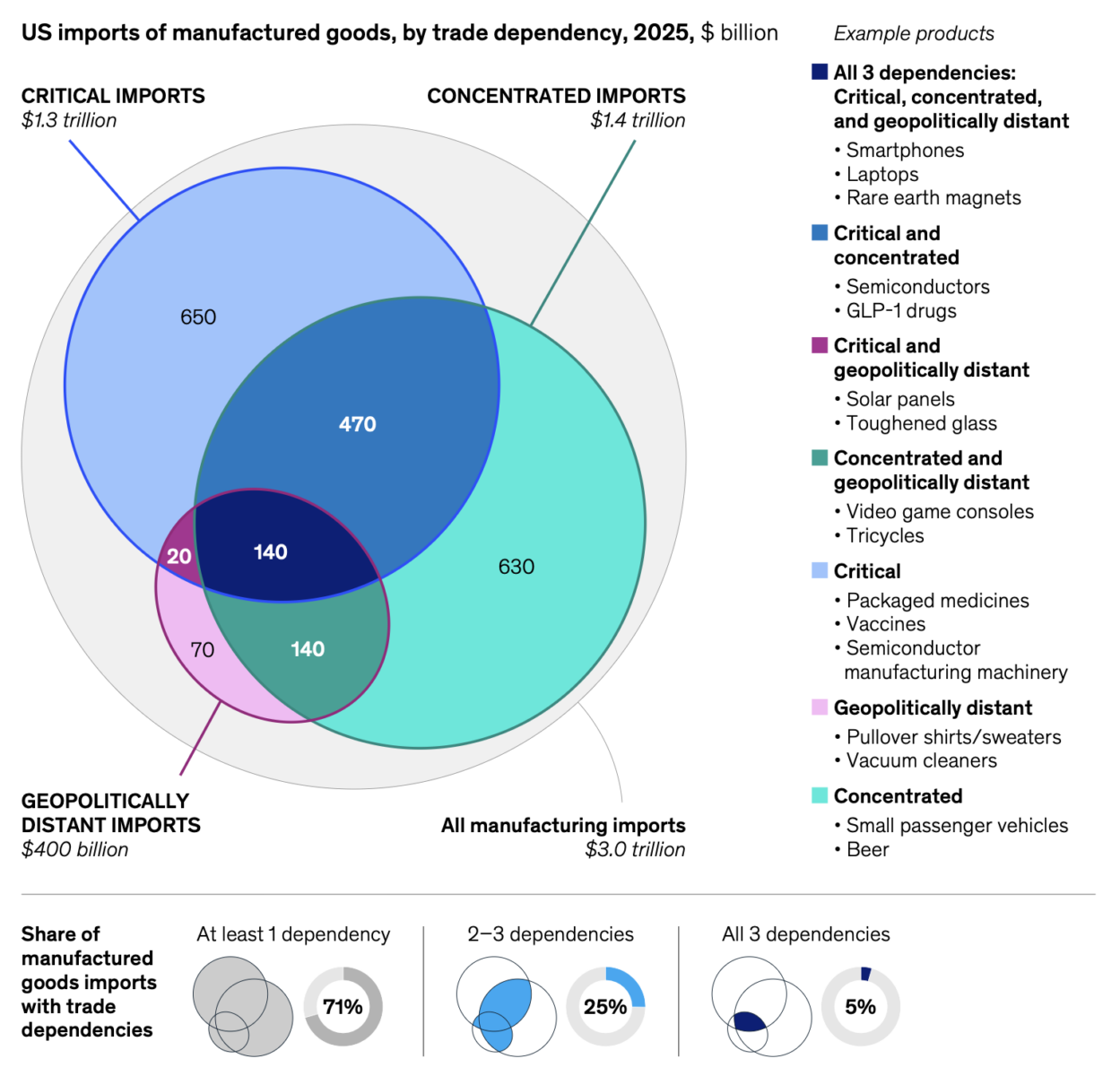
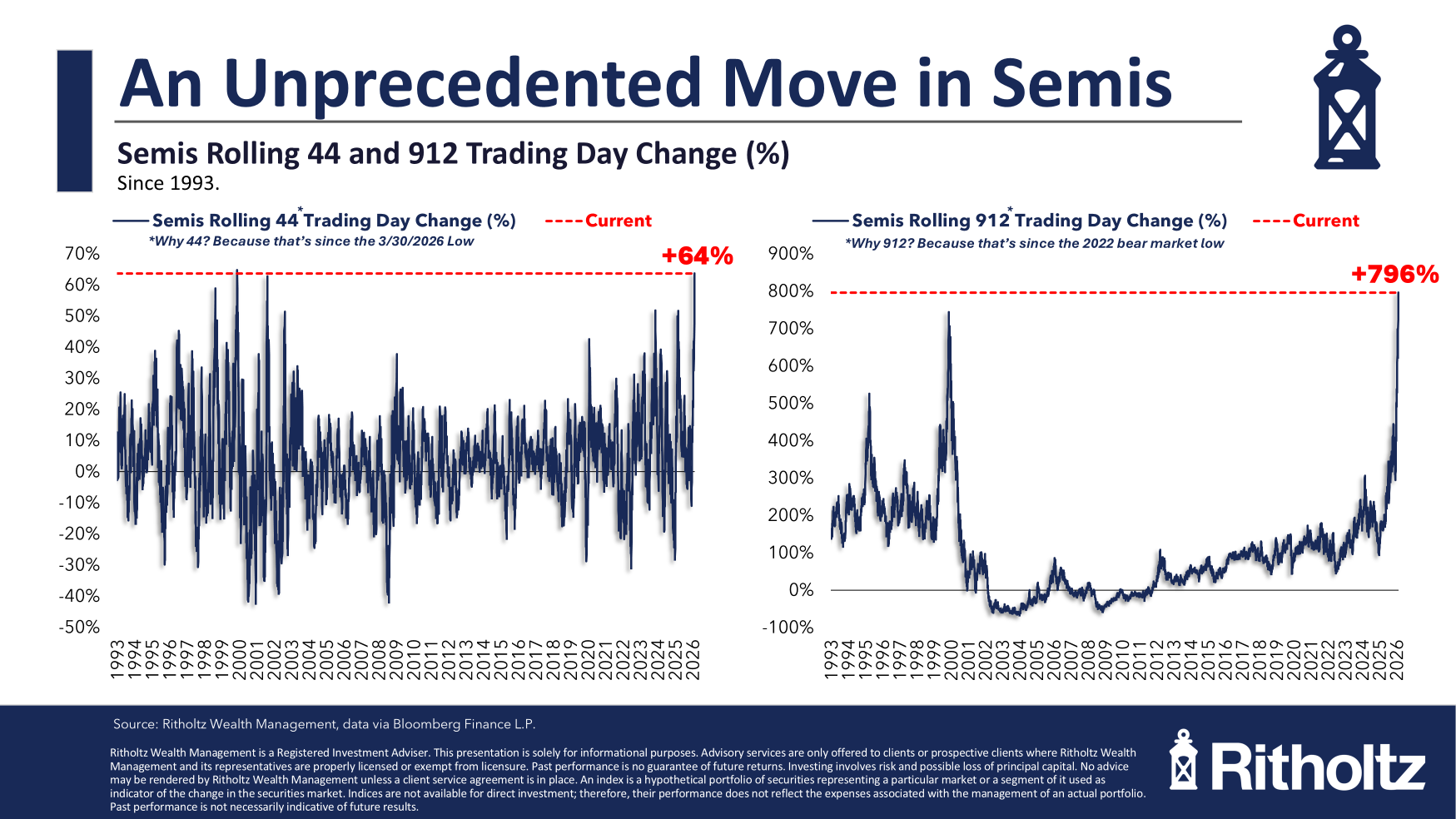
25% of manufactured goods imports have two or three trade dependencies

Source: McKinsey


Sign up for our reads-only mailing list here.

~~~

To learn how these reads are assembled each day, please see this.


The post 10 Weekend Reads appeared first on The Big Picture.

Nobody Knows Anything, SpaceX IPO edition


Of all the dumb things Wall Street is infamous for, perhaps none is sillier than the all too regular forecasting game. Quarterly earnings, Non-farm payrolls, annual S&P predictions, oil prices, inflation rates, FOMC cuts — its a never-ending parade of predictions, most of which are laughable.

Guessing the revenues and profits of any company is tough enough; it becomes even more difficult for any company with only a few years of history.

Allow me to present to you Exhibit A in whatever subsequent litigation arises, via the WSJ:

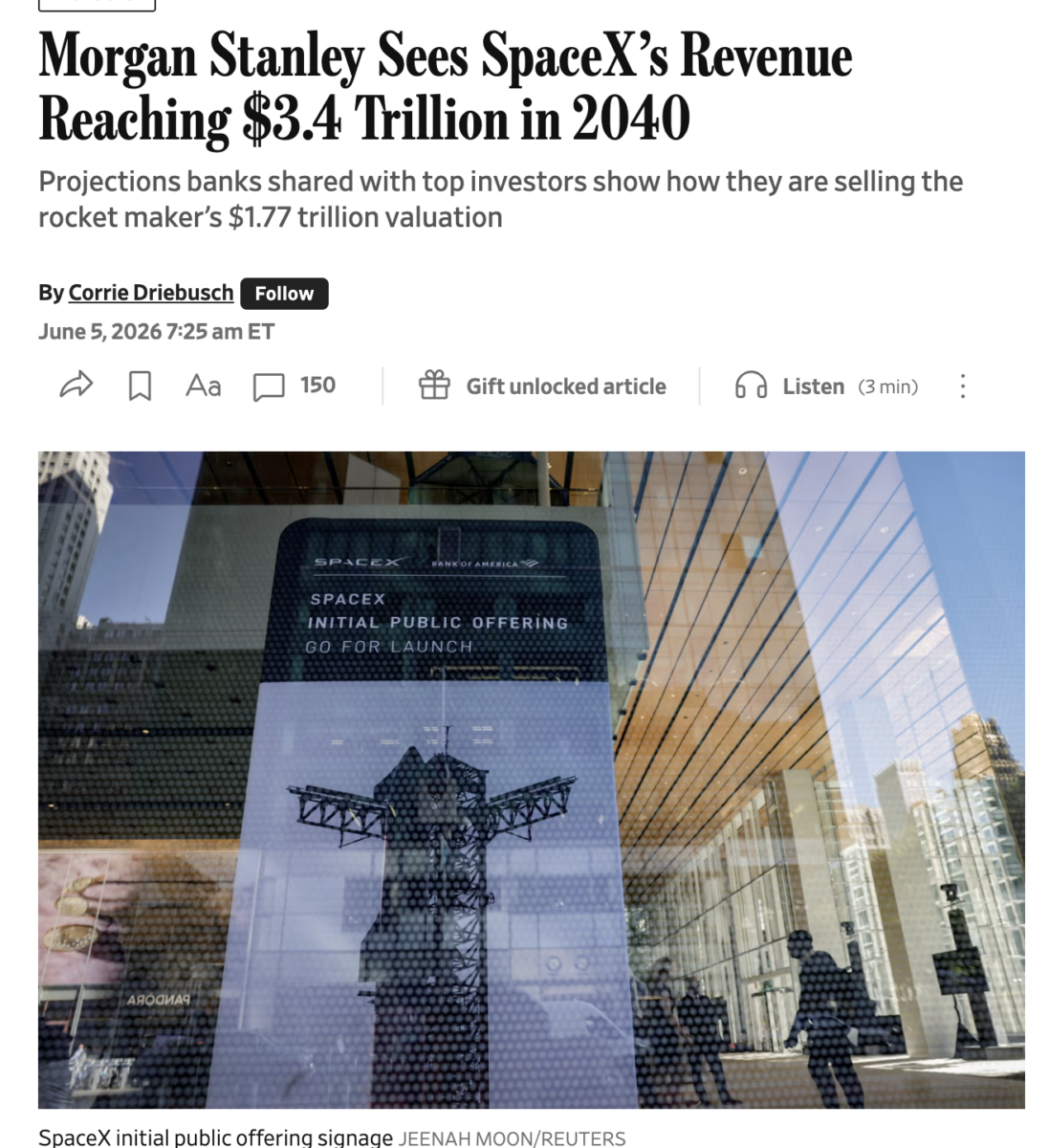
“SpaceX’s revenue could reach $3.4 trillion in 2040, according to a Morgan Stanley analysis shared with top investors Thursday, according to people familiar with the matter.

Morgan Stanley told investors the rocket maker’s adjusted earnings before interest, taxes, depreciation and amortization in 2040 could top $2.7 trillion, the people said.”

I find it hilarious that anyone imagines they forecast revenues and/or profits a decade and a half into the future, let alone $3.4 trillion. Hey, you gotta move some shares, and this seems to be one way to accomplish that.

Just recall whatever you were thinking back in 2012 about 2026 (or the early 2010s about the mid 2020s)  — was Artificial Intelligence the top of your list? Intel finally rallying after the US government took a 10% stakle in it? Korea up 4X? GameStop / meme-stock short squeeze? Silicon Valley Bank / digital bank run? 500 basis point rate hikes in 2022? Did you anticipate the pandemic, the rise of EVs, the invasion of Ukraine, or either Trump elections? January 6, or October 7? A treatment/cure for Pancreatic Cancer?

The world is composed of countless co-variables — not only things we cannot predict, but also secondary effects and unforeseen consequences that are even more impossible to forecast — the further out you look, the number of possible outcomes increases exponentially.

So much happens over the course of a year that it makes forecasting challenging; 10-15 years into the future is utterly laughable.

Look, I get it, analysts’ jobs are hard enough as is, and many of them are justifiably terrified about being replaced by Claude.

Still, f*ckery tomfoolery like this does not give one confidence in this IPO process…


Previously:
Nobody Knows Anything (Archive)

Is SpaceX IPO Breaking Capitalism? (May 13, 2026)

The Folly of Forecasting (June 7, 2005)


See also:
SpaceX won’t make the S&P 500 (FT, June 5, 2026)


Source:
Morgan Stanley Sees SpaceX’s Revenue Reaching $3.4 Trillion in 2040
By Corrie Driebusch
WSJ, June 5, 2026


The post Nobody Knows Anything, SpaceX IPO edition appeared first on The Big Picture.

10 Friday AM Reads

My end-of-week morning train WFH reads:

Congrats. You’re About to Unwittingly Make Elon Musk a Trillionaire. SpaceX is IPOing next week. And there’s a good chance you’re gonna own a portion of it—whether you like it or not. (The Bulwark)

Oil industry warns Trump administration of price spikes within weeks: Politico on the API and major-producer warnings going into the White House — Hormuz risk, tanker insurance, refining maintenance, all aligned the wrong way. The Semafor piece’s nervous companion. Industry executives said the loss of oil through the Strait of Hormuz is draining petroleum inventories to dangerously low levels. (Politico) but see Why isn’t oil more expensive? With peace talks between Iran and the US in limbo, one of the main questions looming over global energy markets is why the price of oil isn’t much higher than it is. Semafor on the puzzle of mid-$60s crude in the middle of an Iran war — Saudi spare capacity, US shale resilience, and demand softness all pulling in the same direction. The bear case in one note. (Semafor)

The United States Capital Structure.The U.S. federal government is arguably the largest issuer of safe debt in the world: roughly $28 trillion of marketable Treasury debt. These Treasurys are backed only by the full faith and credit of the United States Treasury. There is no specific source of revenue that is earmarked to pay back these Treasurys, unlike, say, municipal bonds that are backed by toll revenue. How safe are these promises, really? (The Two Cents)

After 60/40: The Hidden Cost of Uninvested Capital Through the J-Curve. When building a strategic private markets allocation, the waiting period can carry a meaningful cost. The question is not only how to access private markets, but how to manage uncalled capital during the ramp-up period. Apollo making the case for private-markets allocation by costing out the cash drag during the J-curve. Sponsored research, but the framework is worth the read regardless. (Apollo)

I Fed the People Building the Metaverse: A former Reality Labs caterer’s essay on what cooking inside Meta’s metaverse division actually looked like. The food sociology of a tech-cycle bust, told with affection. (Yeast Confections)

How much more software do we really need?: Probably a lot, but not necessarily the kinds people have made money on so far. Noah Smith with the question every VC deck quietly avoids — the marginal utility of net-new SaaS in a market already drowning in seat licenses. A useful counterweight to AI-app exuberance. (Noahpinion) see also What We Learned About the AI Threat From Q1 Software Earnings: In most cases, the death of software companies has been exaggerated, according to Morningstar analysts. (Morningstar)

1,000 True Fans. To be a successful creator you don’t need millions. You don’t need millions of dollars or millions of customers, millions of clients or millions of fans. To make a living as a craftsperson, photographer, musician, designer, author, animator, app maker, entrepreneur, or inventor you need only thousands of true fans. Kevin Kelly’s 2008 essay, still the cleanest articulation of the creator economy. Re-reading it in 2026 is a useful reality check on what actually scaled and what did not. (The Technium)

Sticker Shock at the Pump Fuels a Surge in Hybrid Sales: Sales of hybrid cars carried the day in May as buyers seek better fuel economy. WSJ on the consumer pivot the auto industry kept saying would not happen — buyers walking past pure EVs to hybrids the second gasoline tipped. Toyota, of all companies, was right. (Wall Street Journal)

This Is the Formula That Defeated Orban. It Would Defeat Trump, Too. outlandish xenophobic and antisemitic propaganda had served Orban well for years. It didn’t work against Peter Magyar — probably because so many Hungarians got to see him in person, many of them repeatedly. This is another lesson of his success: Old-fashioned in-person politics can be a powerful antidote to media fearmongering. NYT opinion on the Hungarian opposition playbook that finally landed — coalition discipline, local infrastructure, and abandoning the moral-high-ground talking points. Specific, transferable, worth the read. (New York Times)

Emily Blunt Was Drunk in a Club When a Phone Call Changed Her Life: WSJ profile of Emily Blunt pegged to the new Devil Wears Prada follow-up. The opening anecdote earns the headline; the rest is better than the celebrity-profile genre usually allows. The English actress is having a blockbuster year, between reprising her breakout role and starring in Spielberg’s ‘Disclosure Day’ (Wall Street Journal)

Video of the day: How Shakespeare Manipulates An Audience

Be sure to check out our Masters in Business interview this weekend with Chris Davis, Chairman and Portfolio Manager of Davis Funds. The firm oversees $20 billion in client assets, with Davis (and colleagues) co-investing $2 billion in their own mineus alongside shareholders. Davis was named Morningstar’s Portfolio Manager of the Year; he also sits on the boards of Berkshire Hathaway and Coca-Cola.


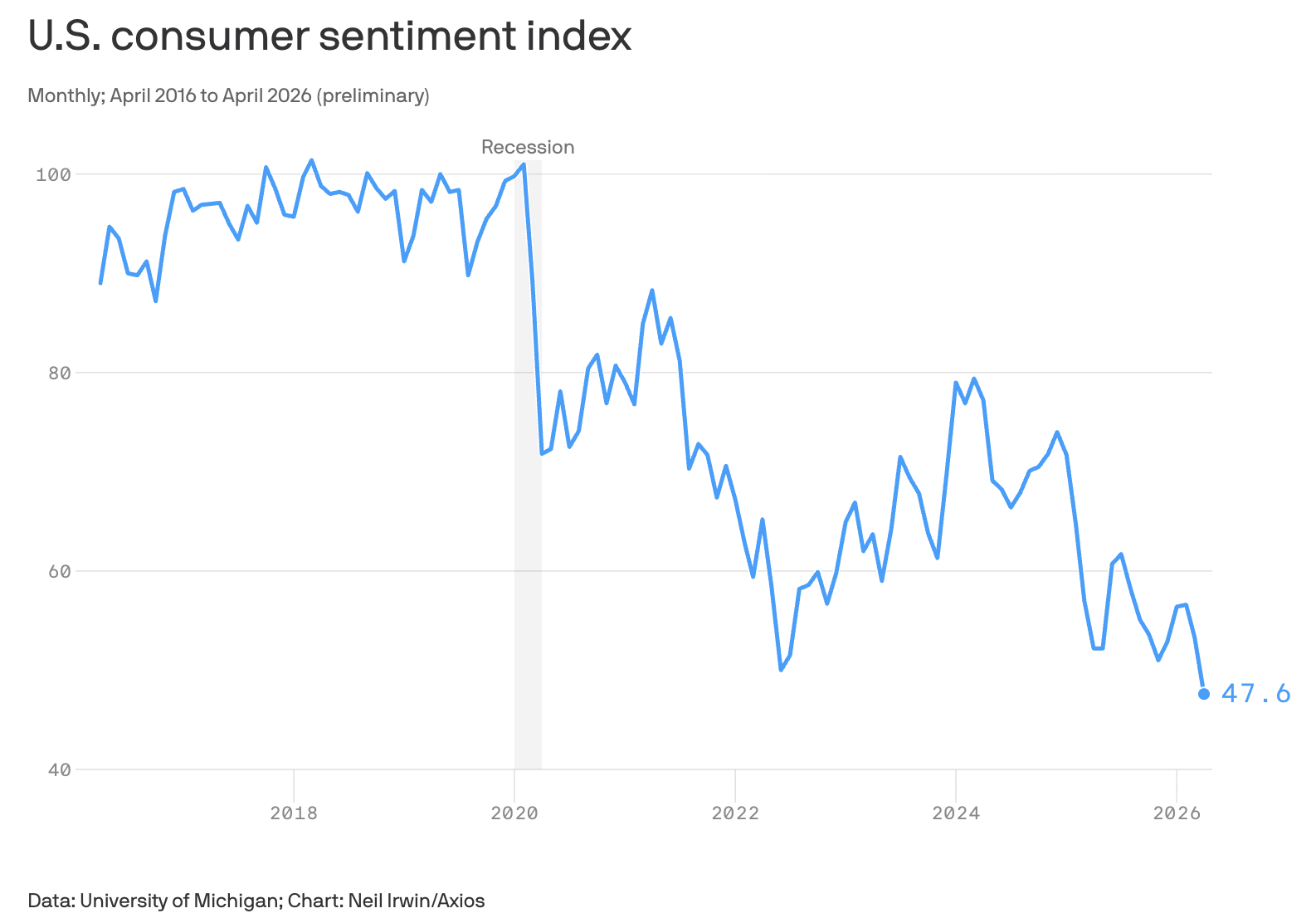
Consumers are in a foul, foul mood

Source: Axios


Sign up for our reads-only mailing list here.


The post 10 Friday AM Reads appeared first on The Big Picture.

At The Money: Grab Your Summer Rental Soon Now!


At The Money: Grab Your Summer Rental Soon!! (June 3, 2026)

It’s not too late to get your summer rental! But many of the prime locations have already been snapped up. If you want to get to the lake, beach, or mountains, you’d better hurry!

Full transcript below.

~~~

About this week’s guest:

Jonathan Miller is a partner at Street Matrix, founder and President of Miller Samuel. His weekly Housing Notes are read widely throughout the Real Estate industry.

For more info, see:

Miller Samuel Bio

LinkedIn

Twitter


Previously:
At The Money: Buying a Vacation Home (June 19, 2025)

At the Money: The Best Way to Buy a House Right Now (November 15, 2023)

~~~

Find all of the previous At the Money episodes here, and in the MiB feed on Apple PodcastsYouTubeSpotify, and Bloomberg.

And find the entire musical playlist of all the songs I have used on At the Money on Spotify


TRANSCRIPT:

At the Money — Summer Rentals
Barry Ritholtz with Jonathan Miller


Intro:
I’m gonna soak up the sun
I’m gonna tell everyone to lighten up
I’m gonna tell ’em that I’ve got no one to blame


Barry Ritholtz: Memorial Day weekend has come and gone, but if you’re thinking about getting a place for the summer, you better get a move on it. There’s still inventory around, but a lot of the prime spots, they’re already spoken for. I’m Barry Ritholtz, and on today’s At the Money, we’re going to talk about summer beach rentals. Renting, buying, what’s hot, what’s not.

To help us unpack all of this and what it means for your tan lines, let’s bring in Jonathan Miller. He’s the director of markets for Street Matrix and co-founder of Miller Samuel. His market reports cover all sorts of summer and beach-related areas, including the Hamptons, the North Fork, the Jersey Shore, all along the rest of the country that has an active vacation property.

So, Jonathan, before we get into the details, let’s start really broad. What does the summer rental market tell us about the broader real estate market?

Jonathan Miller: Well, I think it’s a matter of consumption spending. When the economy’s doing well, they see beach rentals as another commodity that they can buy. I grew up in Rehoboth Beach, Delaware, which was the Hamptons of Washington, DC. It was nicknamed the Summer Capital. And the hotel occupancy—my dad had a hotel there—you could see it fluctuate depending on how well the economy was doing in DC itself. It was quite direct.

Barry Ritholtz: Around here, the Hamptons gets all the attention, and obviously there’s a lot of celebrity and a lot of media out there. But what do you see in other markets like the Berkshires, the Great Lakes, Mountain destinations, Cape Cod? What else is interesting?

Jonathan Miller: So the way I think of it is that, just in the real estate or the housing market itself, there’s this sort of bias towards the higher end. I don’t mean the very, very top of the market. But the more affluent somebody is, the more likely they are to go to one of these vacation spots.

With rising interest rates, that’s making home ownership for primary residences more expensive. That’s reducing traffic to locations that are more dependent on working- and middle-class consumers.

I look at it as there’s been this sort of change in the way consumers are thinking about summer rentals. And a broker, a friend of mine out in the Hamptons, gave me a name for it. It’s called Amazonified—

Barry Ritholtz: Appified?

Jonathan Miller: Amazonfied, which is people are more inclined… Hey, listen, you run out of mouthwash, you just open your phone and you order it, right? You want a summer rental, you just open your iPhone and you start looking at it. And there’s an understanding that you can get it at the last minute.

When my parents used to have a home on Shelter Island in the Hamptons, basically if you weren’t rented for the season by February, then it was kind of a failure, or it was an underwhelming performance. Now it’s last minute. And so one piece of evidence of this was that there was a noticeable uptick in traffic after Memorial Day, which would historically be when the market’s over. And there’s also a lot of thought that that’s going to be the same story after July 4th, which is the last marker for the beginning of the rental season. I think coming out of the pandemic, the orientation towards last minute is a structural change that’s going to be with us indefinitely.

Barry Ritholtz: It’s funny you say that. My experience with Fire Island during grad school was you would put together a share house in October. Like, February is way late. Like October, November for the following Memorial Day.

And I look at a website like Out East—4,500 Hamptons rentals available, including 1,077 in East Hampton, 889 in Southampton, active listings still available for June, July, August through Labor Day, short-term or full season.

This isn’t so much an economic indicator as it is just an app-ified world. We’re just used to everything on demand. Order a movie on demand, order toothpaste on demand, order a summer beach house on demand?

Jonathan Miller: I think that’s the way to think of it. And what’s interesting is, on one hand there’s inventory available, a fair amount of inventory. Part of that is because during the pandemic we had rental property that had annually been traditional rental property. That was all purchased, and so now we have a new universe of renters that are effectively early or recent home buyers. And so we have a whole new market developing.

But I do think there’s going to be absorption of a lot of inventory over the next, call it, month. But the way to think about the market is rents are still on the high side, but not at record levels. Rents are returning to pre-pandemic levels.

I don’t know if we could call it normalizing. You know, the old joke—what does normal mean anymore? But it doesn’t seem to be the frenetic or frenzied environment that it’s been. I don’t know if you could use the word deals, really, but it’s certainly an expensive market still.

Barry Ritholtz: So I know what a data wonk you are. How do you think about summer rentals? Are these luxury goods, housing substitutes, or even a leading economic indicator?

Jonathan Miller: So I see this as just another form of consumption, a luxury good. I don’t see it as an economic indicator, because where the demand is emanating from is probably already the economic indicator to focus on. This is just an extension of it, as opposed to its own independent thing telegraphing where the economy’s going.

A lot of the Hamptons, or East End, demand has been possible from a pretty good bonus season the last couple of years. Compensation is certainly elevated. But even with that, it’s showing that it’s not sold out, or rented out.

I think it’s a combination of people waiting till the last minute and the market not being as intense or frenzied as we’ve been used to over the last two or three years. It’s not a weak market. It’s more normalizing, I think, is a fair description.

Barry Ritholtz: I think of the overall consumer economy as very much K-shaped. There’s the upper—pick a number, 1, 10, 15%—and then there’s everybody else. It’s really bifurcated. Are we seeing something similar? Strong luxury demand, perhaps some softness in the middle or bottom of the rental market?

Jonathan Miller: Absolutely. I think that’s a very fair description of what rental markets are generally looking like. They’re an extension of the primary markets, and the primary markets are generally—call it the upper half is faring better than the lower half—only because of less reliance on interest rates, and also maybe more dependence on the performance of the financial markets.

Barry Ritholtz: So all right, we’re spending a lot of time talking about Wall Street bonuses and the Hamptons. What about the rest of the country? What about mountain destinations, the Sun Belt, California, lake communities? There’s so much more to a holiday or vacation property beyond the East End of Long Island.

Jonathan Miller: Yeah, although if you’re in Long Island and are on the East End, I think that’s all you see.

That’s all that matters, at least when I was out there a couple weeks ago. I think with all the uncertainty in the economy, economic uncertainty, it’s a little surprising to see normalized second-home market activity, but it’s really skewing, again, like the Hamptons. I don’t think the Hamptons is performing any differently than most second-home markets. I remember during the housing bubble build-up, it seemed like everybody I knew had a modest-priced second home in New Hampshire or Vermont. And they would go there on weekends, spend their summers there.

I don’t think you’re seeing as much of that as you have in the past, because a lot of that is mortgage-rate sensitive. I think you’re seeing, whatever region of the country, this sort of—I don’t know if I’d call it bias, but you’re seeing activity skewing a little bit higher than the middle of the market.

Barry Ritholtz: So what does that mean for different regions? Let’s talk about the Berkshires, or I know people who were in Texas, New Mexico, Arizona, where it’s so hot in the summer they like to go to San Diego, La Jolla, Southern California, where it’s 75-80 and sunny during the day and 65 and delightful at night. What are you seeing in other regions?

Jonathan Miller: I don’t mean to be a broken record, but I’m seeing something very similar. It’s this idea that consumers are going to the traditional second-home locations that are linked to their markets—like you were describing, people leaving Texas in the summer. We’re seeing all that. It’s confusing in a way, because we’re getting so much bad take about what’s going on in the economy, inflation, and yet we’re still seeing this activity.

What’s a little different about it is that across the US it’s not really frenzied at all. It’s just active. Pricing is not as high as it’s been, but you still see a fair amount of activity. It’s just not some sort of insane frenzy that we’ve been going through for the last three or four years.

Barry Ritholtz: You mentioned mortgage rates earlier. I’m curious—obviously mortgage rates have an impact on price, and vice versa, but what does that mean for renters? Especially in a market where so many of the buyers seem to be straight-up cash buyers.

Jonathan Miller: The higher the interest rates, the higher the rent, is the way I look at it. And the reason for that is you have people that are on the fence about buying a second home. But they’re concerned about whether they’re going to get their price, so they’re renting it out, maybe to the same people every season, and that reduces inventory, which puts at least stabilizing or higher price pressure on rents. So I don’t see this as… When rates rise, I think that’s just going to make it more difficult, whether to purchase a second home or to rent one, because it just pushes everything up.

Barry Ritholtz: So I’m curious. You’re implying that people who might be buyers one day are sort of putting a toe in the water with renting. Is this a fairly common process? People rent, they like an area, and then they buy over there. Is that fair?

Jonathan Miller: Yes, I think that’s fair. The idea is that you test out the market for a summer, or for a month, or for a couple of weeks and see if you really like it, versus just driving there or flying there for the weekend.

And that is the nature of second-home markets. They move a lot slower. The second-home market for California is Idaho, Wyoming. You don’t just go there for the weekend—You’re going to test it out, maybe take a year or two. We see that all the time—friends of mine that have rented for a few years.

My parents went through this with their rental property in Shelter Island. After a couple seasons, the tenants that they loved ended up buying the house down the street, just because they loved the area.

Barry Ritholtz: So one of the things I’m astonished about—and again, my frame of reference is the Hamptons, where our vacation property is—but I am seeing an astounding amount of construction. Any house that’s sold is either, if it’s turnkey, it sells quickly, and if it’s not, it’s knocked down and a 7,000-foot behemoth gets put up in its place. West Hampton, Sag Harbor, East Hampton, Sagaponack—wherever I go out there, it’s shocking, the degree of construction. Every builder, every contractor seems to be fully booked.

What is driving this? Is this specific to the New York bonus season, Wall Street bonuses? Or are you seeing this around the country in other ritzy vacation areas?

Jonathan Miller: We are seeing this around the country. I think the easiest cause and effect is the Wall Street compensation picture of the last couple of years that’s really driving it.

Having been out to the Hamptons a couple times in the recent month or two—they call it the trade parade, right? All the trades coming in early in the morning and then leaving before rush hour.

Barry Ritholtz: By trades you mean, you mean plumbers, electricians, tilers…

Jonathan Miller: And it’s just the traffic— yeah, electricians, roofers, builders. It’s unbelievable.

So residents there plan their day around when they can leave and come back, because—as they call it, the Trade Parade—is so incredible. And the challenge is that those workers really are stuck in two- or three-hour traffic jams, which is a real challenge. But there’s so much demand for their services, and they can’t afford to live there, so they’re coming from a good distance away.

Barry Ritholtz: Well, that’s why they start at 7:00 and leave at 3:00. That makes a lot of sense.

We’ve seen the real estate market sort of normalizing after COVID. Certainly the reactions are less frenzied than they were during the pandemic. Has COVID permanently reset prices and house-buyer behavior and even expectations?

What’s the lasting impact of the pandemic on the summer vacation market?

Jonathan Miller: So I think structurally, COVID has changed—and probably extended—the use of second homes, because of things like Zoom. But it’s also become a little less predictable because of, as I mentioned earlier, the Amazonification of demand. Everything is sort of last minute, as opposed to relying on tried-and-true forecasting patterns.

But it’s a market that is going to be tested. The weaker the economy, the weaker the demand for second-home markets. But they don’t flip on and off. There’s still a base level of demand. The problem is that the demand is coming from a skewed portion of the population—upper half versus lower half is the way I prefer to think of it—and that creates a sort of void in the demand needed for more modest-priced second-home housing.

Barry Ritholtz: You know, we talk about the Hamptons as a second-home vacation market. There’s a $2.5 million rental there for the season, which I find astounding. But if you can’t afford that, maybe you pay a million and a quarter for the month of July, or a million for August. Now, to be fair, that $2.5 million rental does come with both a chef and maid service. So you get a lot of services for your money.

Jonathan Miller: Yes.

Barry Ritholtz: And I am not joking, because I have—like you, I am a Zillow lurker, and I look at all this crazy stuff.

Jonathan Miller: Yeah.

Barry Ritholtz: So to sum up: all right, you missed Memorial Day, but there’s still a lot of summer left. And if you’re thinking about a house on the lake, a house up in the mountains, maybe by the beach, there’s still some inventory left—but you better get a move on it, and you better start working on that tan. Please use SPF. I’m Barry Ritholtz. You’ve been listening to Bloomberg’s At the Money.

~~~

Find our entire music playlist for At the Money on Spotify.


The post At The Money: Grab Your Summer Rental Soon Now! appeared first on The Big Picture.

10 Thursday AM Reads

My morning Montreal reads:

Shorting SpaceX? Jefferies Becomes Go-To Bank After IPO Miss:  It’s the kind of look that ambitious investment bankers usually strive to avoid: When SpaceX named the roughly two dozen firms handling its IPO, Jefferies Financial Group Inc. was conspicuously absent. But behind the scenes, bearish investors and some of Jefferies’ own bosses see that as a unique opportunity. (Bloomberg)

Who Let the Professors Out? Inside CFM: The $27bn quant on Paris’ Left Bank: Stock markets are surging, and momentum is rampant. It made me think of CFM wizard Jean-Philippe Bouchaud who believes that it is fund flows that drives markets and not fundamentals. (Rupak’s Substack) see also Transcript: Jean-Philippe Bouchaud, Founder/Chief Scientist, Capital Fund Management co‑founder, chair & head of research/chief scientist atCapital Fund Management (CFM). The $20 billion firm started in 1991 specializing in managed futures and now runs futures and multi-strategy programs. He began his career in theoretical physics, was awarded the IBM Young Scientist Prize (1990) and the C.N.R.S. Silver Medal (1996), and has published over 300 scientific papers and several books in physics and finance. (The Big Picture)

The triumph of capital: It’s been a great generation to have started out rich. If you compare the United States to the famously high-tax Nordic countries, the major difference is not in the top statutory income tax rates. The top American combined state and local tax rate is generally a little higher than it is in Norway and a little lower than in Denmark and Sweden. New York and California, where a large share of our billionaires live, have unusually high top income tax rates, so the richest people are paying Nordic-level marginal rates. (Slow Boring)

Sorry Marc, it — investment grade private credit — is just not that big: The FT, gently, on Marc Rowan, Apollo’s CEO,  latest “this is the biggest thing in history” essay — and the multiple times he has said exactly that before. The kindest version of the takedown. (Financial Times)

Gmail Thinks I’m Stupid, So I Left: A nicely irritated post on Gmail’s creeping infantilization — AI summarizing nothing, hiding addresses, “smart compose” doing the opposite. The user case for going Fastmail/Proton in one sitting. (Modded Bear)

• High Density Living, 2000 Years Ago: Inside the Roman Apartment Building: Ancient Rome had six-story walk-ups, noise complaints, and absentee landlords. The more things change. A tombstone outside Rome bears “The Tenant’s Lament”—proof that housing has always been a problem. (Common Edge)

This $50,000 Safety Fix Is Dividing the Aviation Industry and Washington: Federal safety officials and lawmakers have been at odds over mandating systems enabling pilots to see nearby aircraft (Wall Street Journal)

Iran Atomic Risk Seen Higher Than Before Trump Attacks Began. The risk that Iran is covertly pursuing nuclear weapons is higher today than before the US and Israel launched their first military attacks on the Islamic Republic a year ago, according to western officials. The International Atomic Energy Agency has warned member countries about new nuclear proliferation dangers posed by Iran’s large inventory of near-bomb-grade uranium, which is no longer subject to weekly IAEA inspection. (Bloomberg free)

Cancel Culture at CBS News: The Bulwark on the Pelley/Weiss/Bilton triangle and what it tells you about who the new CBS News editorial line is for. The “cancel culture” framing applied where the people doing the cancelling actually are. (The Bulwark) see also Scott Pelley Fires Back After “60 Minutes” Ouster: “The Collapse of Values at the Top Has Become Untenable”: Variety carrying Pelley’s on-the-record statement after the firing — the kind of clean, scorched-earth quote that doesn’t happen at CBS News by accident. (Varietysee also When “60 Minutes” is in Trouble, We are All in Trouble: Jim Acosta on what the Pelley firing means for the rest of the press corps. Read alongside Margaret Sullivan’s “priced in” piece — same diagnosis, fresh data point. (Jim Acosta)

He Was the Knicks Owner Who Could Do Nothing Right. Now James Dolan Can’t Miss.: WSJ on the strangest sports-business arc of the decade — Dolan, of all people, with a Finals team and a cleaner front office than half the league. Even Knicks fans aren’t sure what to do with this. (Wall Street Journal)

Video of the day: What It’s Like to Be a Billionaire’s Family Member

Be sure to check out our Masters in Business interview this weekend with Chris Davis, Chairman and Portfolio Manager of Davis Funds. The firm oversees $20 billion in client assets, with Davis (and colleagues) co-investing $2 billion in their own mineus alongside shareholders. Davis was named Morningstar’s Portfolio Manager of the Year; he also sits on the boards of Berkshire Hathaway and Coca-Cola.


The Lowest Consumer Sentiment EVER

Source: A Wealth of Common Sense


Sign up for our reads-only mailing list here.


The post 10 Thursday AM Reads appeared first on The Big Picture.

5 Things I Am Thinking About


I keep hearing comments and concerns about these markets in the media. Since my wife is tired of me yelling at the television (“No! That’s wrong!”) you are the lucky recipients of my ire.

Here are five things I have been thinking about regarding markets, the economy, and investments – from the most bullish to the least – that are too easily misunderstood:

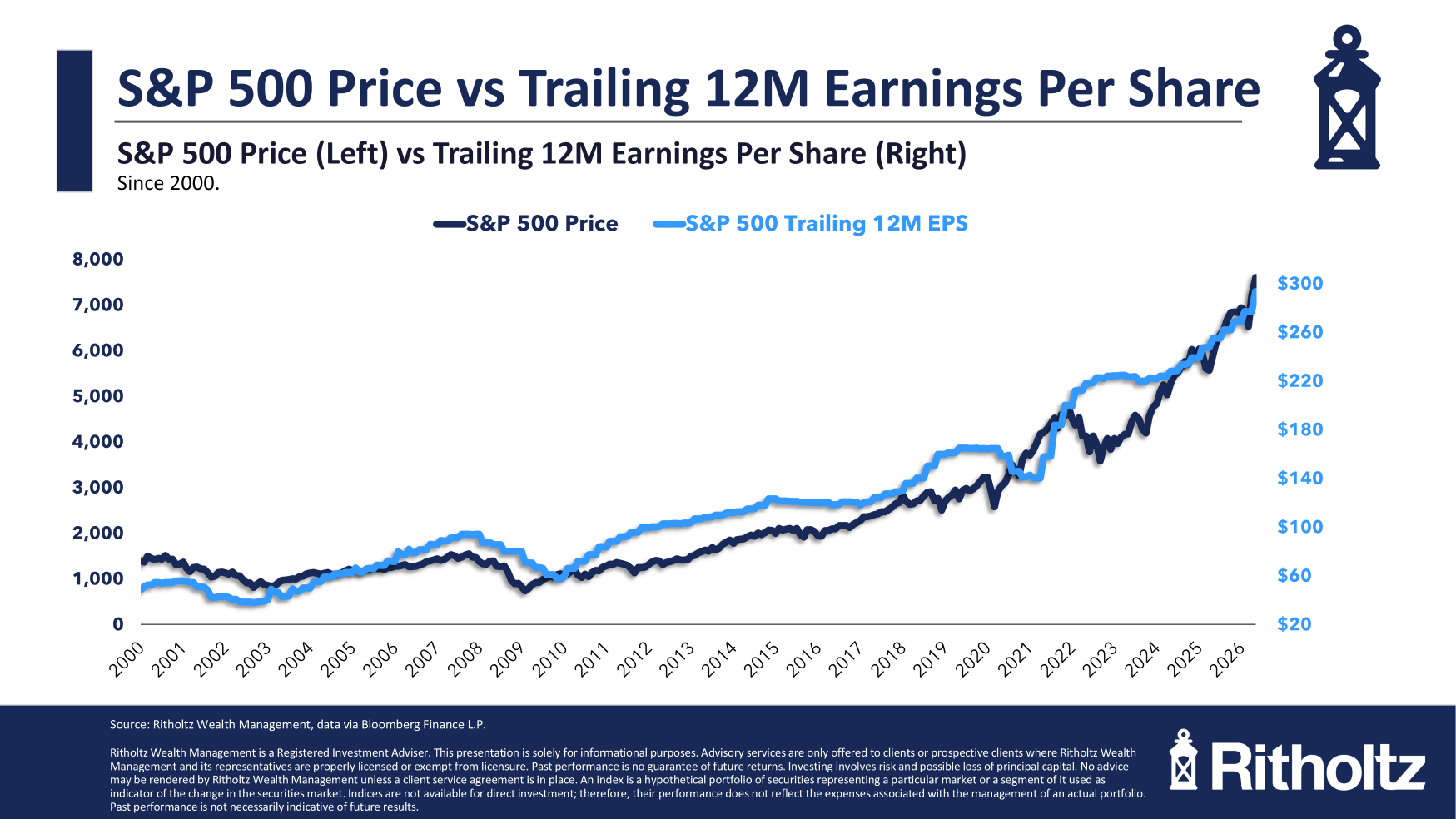
1) Profits: If I can only look at one data point to gauge the overall direction of equity markets, it would be profits. And, corporate profits have been on a tear the past few years.

To be sure, the hyperscalers’ artificial intelligence buildout and massive CapEx are significant factors. But we have also seen good profits in sectors ranging from Communication Services, Health Care, Financials, Consumer Discretionary, and Materials — all are having strong quarters; (unsurprisingly, Consumer Discretionary is the least consistent).

And these are not just one-time blips; we have enjoyed the rare combination of record profits and record profit growth rates. If you want to understand what has been driving equity prices, look no further than this powerful one-two punch.

At the same time, high(ish) valuations have become a little cheaper, as multiples have compressed. This is very powerful…

2) All-Time Highs: The data is unequivocal. Investing at all-time highs yields better returns than at all other dates. I have been saying this for years, so rather than repeat myself, I will let Sam Ro give you the details:

“Just because major market drawdowns are often preceded by record highs doesn’t mean all-time highs are often followed by major market drawdowns. Hopefully, this is obvious. The stock market would not have trended higher for decades if this were not true. Eyeball any long-term chart of the stock market, and you’ll see all-time highs followed by new all-time highs.”

There were over 493 new all-time highs from 1983 to 2000. Except for the very last one, every single one of these was bullish.

If you want to make a bet against 500 to 1 odds, well, that’s your call. I am on the other side of that trade.

3) Sentiment: Another intriguing issue that keeps coming up is record lows in U Mich Sentiment. Many find this deeply concerning.

But here is the thing: Your individual sentiment is based on what you experience personally – in BeFi terms, the “Availability Heuristic” of what is in your personal economy. But that is not what drives markets. We discussed this in terms of the pandemic and, more recently, how we can have all-time highs in equities with all-time lows in consumer sentiment.

Most of the time, Sentiment measures do not provide a very clear signal. The contrarian in me looks at record low sentiment measures as a potentially bullish indicator…

4) K-Shaped Economy: Here is the disappointing, grim reality: Throughout most of human history, it has been a very “Winner takes all (or most)” kind of economic system.

The challenge is in having the top 10% of the economic strata driving half of the economic activity. This may not be a sustainable situation — economically or politically.

There were hopes that the industrial revolution, unionization, and the general rise in entrepreneurship might push back against that reality. But it is looking more and more like the Roaring 1920s, the 1980s bull market, the post-GFC bailouts were the norm, not the exception.

I grew up in the post-war era, and I took it for granted that it was the norm. I am starting to suspect exactly how aberrational that period was. It is looking more and more like the entire post-war period – the rise of the middle class, the build-out in the USA of suburbia, interstate highways, the electronics industry, semiconductors, manufacturing, civilian aviation, etc. – was a historical aberration.

I hope this is incorrect, but fear it is not…

Iran War / Oil / Inflation: Venezuela was fast and easy; Cuba is likely a bit more difficult. But Iran has its own strategic, tactical, and military assets; it is its own player in the Middle East. Oh, and they have been supplying drones to Russia (!) for its war against Ukraine.

I have no idea how the Dunning-Kruger War will ultimately play out in terms of energy prices and/or inflation, but it appears not to have been well thought out in advance.

The good news is regional wars generally don’t impact stock prices much; the bad news is this is the one with the potential for causing exactly that kind of mischief…

~~~

Generally speaking, I am bullish on US equities and even more bullish on overseas bourses. There are signs of froth and foolishness, none of which rise to systematic problems.

Am I happy about the excesses surrounding the SpaceX IPO? Absolutely not. The index gaming from Nasdaq and S&P is deeply problematic and disappointing. But it does not read to me as a market killer.

If you have learned anything from this market over the past 15 years, it is that it deserves the benefit of the doubt. The economy has been cooling, but not outright decelerating. Housing is a mess, still working off the excesses of the GFC. College grads seem to be having a hard time finding jobs.

It’s not perfect out there. But until we see deeper signs of deterioration and further economic weakening, I remain constructive…


Previously:
All Time Highs (SP500) versus All Time Lows (Consumer Sentiment) (April 24, 2026)

Maybe Mr. Market Is Rational After All… (August 7, 2020)

The K-Shaped Recovery (September 4, 2020)

No, Market Highs Are Not a Bad Sign (March 5, 2014)

The Bifurcated Recovery in Jobs (November 12, 2013)


The post 5 Things I Am Thinking About appeared first on The Big Picture.

10 Wednesday AM Reads

My mid-week morning plane reads:

• Real-Estate Agents Are Quitting the Slow Housing Market: Four years into a struggling market, even agents who survived the initial shakeout are hitting their breaking point. Fewer sales, longer timelines, second jobs. (Wall Street Journal)

• No, Market Highs Are Not a Bad Sign: The old Ritholtz classic, still relevant—the data on what happens after all-time highs is the opposite of what most people assume. (The Big Picture) see also New All-Time Highs: Since 1950, roughly 7% of all trading days have been new all-time highs. The highest percentage of trading days hitting new highs in a decade is the 1990s at 12.3%. This decade is far from over but we’ve experienced new highs in the S&P 500 in 13% of trading days. (Wealth of Common Sense)

• The Great Wealth Transfer Includes $570 Billion in Classic Cars: Boomers are about to hand off a staggering collection of vintage automobiles. The question is whether anyone under 60 wants them—and what happens to prices when supply floods the market. (Bloomberg)

• Best ETFs 2026: The Morningstar Award for Investing Excellence Winners: Morningstar’s annual ETF honors—the funds that earned top marks for performance, cost efficiency, and risk-adjusted returns. (Morningstar)

• Grocery Shoppers Are In For a Summer of Pain: The Iran war is driving up food costs, and the tariff aftershocks aren’t helping. Expect higher prices at the register through the fall. (Bloomberg)

America’s Favorite Comedian Wants to Be the Next Walt Disney—and He’s Not Joking: Nate Bargatze, the country’s top selling stand-up comic, has a grand ambition: a $350 million theme park in Nashville, Tenn. (Wall Street Journal)

• If You Take the Weasel Job Then You Must Be the Weasel: Hamilton Nolan on the moral clarity of job titles—if you accept a role that requires you to do terrible things, you don’t get to pretend you’re not the one doing them. (Hamilton Nolan)

• I Want It, But I Don’t Like It: A sharp essay on the gap between desire and enjoyment—why we keep pursuing things that don’t actually make us happy, and what that says about modern consumer psychology. (Panoptica)

Jimmy Kimmel ‘Felt Defeated’ by Stephen Colbert’s Cancellation and Says Late-Night TV Is Not ‘Dying of Natural Causes’: ‘We’re Being Poisoned’ The “Jimmy Kimmel Live!” host opened up in a new interview with Vulture about the future of the genre following the cancellation of Stephen Colbert‘s “Late Show” on CBS and his own run-ins with Trump, including his suspension following comments made about the death of Charlie Kirk.  (Variety)

• Knicks-Spurs NBA Finals mega-preview: Game 1 tips off June 3 in San Antonio. The Athletic’s comprehensive breakdown—predictions, odds, matchups, and everything else you need before the series starts. (The Athletic)

Video of the day: How a Secretive Trading Empire Is Taking Over Wall Street

Be sure to check out our special Masters in Business this week, Remembering Jonathan Clements with Bill Bernstein and Jason Zweig. The two recall Clements’ impact on the investor community; they discuss his posthumous book, “Money and Me.”

The Deal That Keeps the Oil Flowing

Source: Epicenter


Sign up for our reads-only mailing list here.


The post 10 Wednesday AM Reads appeared first on The Big Picture.

10 Tuesday AM Reads

My Two-for-Tuesday morning train reads:

All-time highs have been great times to invest in the stock market: Sam Ro with the empirical companion piece: forward returns from all-time highs have historically beaten forward returns from random days. The chart is the argument. (TKer)

The Spanish Exception: The Atlantic on why Spain keeps outgrowing Europe despite — and partly because of — the political reaction to immigration. The contrarian European data point. (The Atlantic) but see Germany Has Lost What It Did Best: NYT opinion on Germany’s industrial model snapping under the combined weight of energy, China, and tariffs. The Merz government is finding out which post-war assumptions still hold. (New York Times)

If It Walks Like a Bubble and Quacks Like a Bubble, Then It’s Probably a Bubble. Indisputably, there are signs—some of which hark back to the dot-com era—that it is. For instance, take a gander at this not-so-little equation: $1.75 trillion divided by $18.674 billion equals 93.71 times. (Barron’s)

Berkshire Beyond Buffett. In the 60 years he led Berkshire, he returned 6,000,000%, beating the S&P 500 by a factor of 130. Those wanting an education in business could do worse than listening to recordings of those Q&A sessions over the years. They could also do worse than by reading Buffet’s 60 years of annual letters. (The Weekend Reader)

Amazon Thinks the Future of Data Centers Depends on a Technical Problem It Just Solved: The tech giant says a breakthrough in data center networking has dramatically accelerated the flow of information through its massive cloud infrastructure. (Wired)

The SpaceX IPO: How Index Funds Will Adapt: Upcoming mega-IPOs will force tough choices for index providers. (Morningstar)

I Profile Celebrities for a Living. Nothing Prepared Me for Tilly Norwood.: NYT Magazine on profiling the AI “actress” Tilly Norwood — what the interview actually consists of, who the handlers are, and what publicity for a synthetic person looks like in practice. Strange and well done. (New York Times)

The Wild, Strange Case Todd Blanche Can’t Seem to Escape: Vanity Fair on the case that keeps following the President’s lawyer-turned-deputy-AG. The kind of slow-burn legal exposure that doesn’t show up in cable coverage until it does. A fake Mossad agent. Twin grifters. The nation’s top lawman. A head-spinning legal drama has the attorney general fighting off accusations of forgery, malpractice, and more. (Vanity Fair)

How a mysterious particle could explain the universe’s missing antimatter: Knowable on the neutrino results that might finally close the matter-antimatter asymmetry gap. Patient, well-sourced physics writing; pair with coffee. (Knowable Magazine)

The Tall Man Who Changed Basketball: You Cannot Miss Victor Wembanyama: WSJ on Wembanyama’s Finals run and what he is doing to a sport that has not had a true mold-breaker in a decade. Even if you only check in for the Finals, worth it. A mystery not long ago, San Antonio’s star from France has conquered the NBA and vanquished its defending champion. Does New York have an answer? (Wall Street Journal)

Video of the day: The SpaceX IPO… It’s Worse Than You Think

Be sure to check out our special Masters in Business this week, Remembering Jonathan Clements with Bill Bernstein and Jason Zweig. The two recall Clements’ impact on the investor community; they discuss his posthumous book, “Money and Me.”


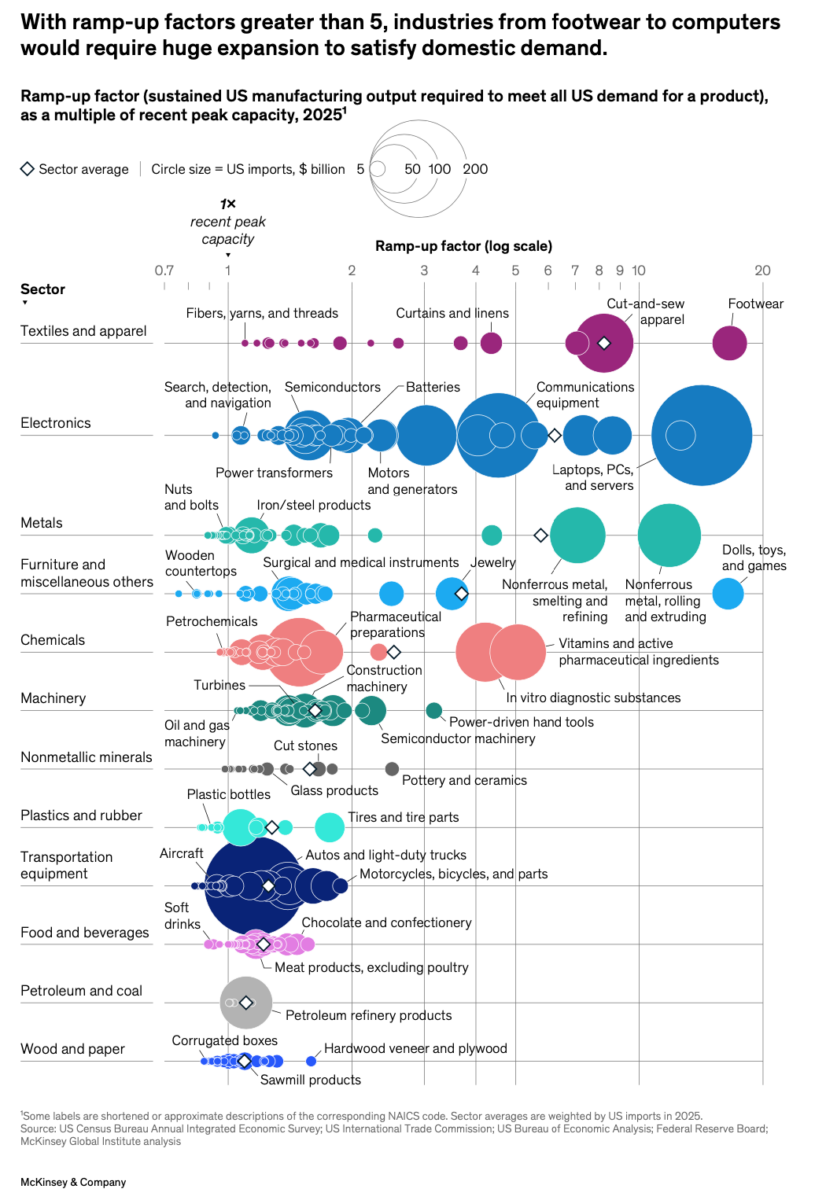
Industries from footwear to computers require huge expansion to satisfy domestic demand


Source: McKinsey


Sign up for our reads-only mailing list here.


The post 10 Tuesday AM Reads appeared first on The Big Picture.

Transcript: Remembering Jonathan Clements with Jason Zweig and William Bernstein


The transcript from this week’s, MiB: Remembering Jonathan Clements with Jason Zweig and William Bernstein, is below.

You can stream and download our full conversation, including any podcast extras, on Apple Podcasts, Spotify, YouTube (video), YouTube (audio), and Bloomberg. All of our earlier podcasts on your favorite pod hosts can be found here.

~~~

Masters in Business: Remembering Jonathan Clements
with Jason Zweig and Bill Bernstein


Barry Ritholtz 
(00:00:16):  This weekend on the podcast, I get to sit down with Jason Zweig and William Bernstein, remembering their friend Jonathan Clements. Jonathan was a Wall Street Journal personal finance columnist and author for almost 20 years. He’s beloved by people in the industry. In many ways, Jonathan has done as much as anybody to push the idea of indexing—at least anybody since Jack Bogle. I thought this conversation, despite the fact that we know Jonathan received a terminal diagnosis and we already know how it ended, was interesting, uplifting, and fascinating. I think you will too. With no further ado, my remembrance of Jonathan Clements with Jason Zweig and William Bernstein.

Jason Zweig  (00:01:05):  Thanks, Barry. Glad to be here.

Barry Ritholtz  (00:01:07):  So let’s start at the beginning. I want to talk a little bit about who Jonathan was. We’ll talk about his two most recent books, including the one coming out in May of 2026. But how did each of you meet Jonathan? What were your early impressions of him like? Let’s start with you, Jason.

Jason Zweig  (00:01:25):  You want me to go first? So Jonathan and I met the third week of March in 1987 when I joined Forbes Magazine. He was already there, and we almost instantly became good friends. I’d say we probably went out to lunch at least twice a week for the next four years—certainly every Wednesday, fish cakes and spaghetti at the New Courtney on 14th Street in Manhattan, which I want to say was $4.95.

Barry Ritholtz  (00:02:06):  The Forbes office was right over there—was it 18th and Fifth?

Jason Zweig  (00:02:11):  Fifth, yeah.

Barry Ritholtz  (00:02:12):  All the Berger eggs were there. The whole building was kind of uniquely—

Jason Zweig  (00:02:16):  Situated. Fifth Avenue and 12th Street. Very close. And Jonathan had a really unusual sparkle. He always had a twinkle in his eye. He thought almost everything was funny—because, of course, almost everything is funny if you think about it the right way. He might be writing about some con artist who was stealing people’s money, or some mutual fund that was overcharging people, but he always found the humor in the situation. I loved that about him. We were friends from that moment on, ever since.

Barry Ritholtz  (00:03:07):  Bill, how’d you meet Jonathan?

Bill Bernstein  (00:03:09):  I met him a little later. It wasn’t until about the mid-nineties, when I was still practicing medicine and finding my feet in finance. I was starting to write, and I did what any aspiring financial writer does, which is you start chatting up financial journalists. He responded, and he started quoting me in the Journal. For many years I was just a source, until maybe the late aughts or early 2010s. Then we became personal friends after that. And he did think everything was funny. He just had such a pleasing personality—a high hedonic set point. He was always in a good mood, and he always thought everything was funny, which is a fabulous combination. The other personal characteristic that powered his career, I think, was that he was willing to talk about the hard things in his life: his struggles with money, his divorces, and of course, in the end, his impending demise. It was those three things together that really made him such a unique financial journalist and human being.

Barry Ritholtz  (00:04:28):  When I was preparing for this, I learned a lot of things I was wholly unaware of, including a quote from you, Bill: that you owe your entire career in investments to Jonathan’s work. You have to explain how a neurologist in North Bend, Oregon ended up having a career change thanks to a personal finance journalist.

Bill Bernstein  (00:04:53):  Well, I happened to live in a country that doesn’t have a functioning social safety net. So I realized I was going to have to invest on my own if I wanted to survive my retirement financially. I approached it the way I thought anybody with scientific training would: I read the peer-reviewed literature, the basic textbooks, and then I collected data and built models. When I was done with all that, I actually had something that was useful to small investors—and in a couple of instances, even to professional investors. So I started writing about it. The internet came to my community about that time, and I put my material on the web, and Jonathan picked it up. He started quoting me in the Wall Street Journal, and that opened the door to getting my books published, and also to a financial advisory business. Like a lot of things in a complex life, it was just serendipity—one thing leading to another.

Barry Ritholtz  (00:05:56):  Really interesting. Jason, you’re with Jonathan at Forbes, and then together at the Wall Street Journal. I’m struck by 1987—not only the year of the great crash, but long before indexing was the dominant intellectual framework, certainly in terms of money flows into mutual funds and ETFs. What was it about Jonathan’s writing that seemed to reshape a lot of the conversation about investing?

Jason Zweig  (00:06:35):  I don’t think this is an exaggeration: more than any other individual except Jack Bogle, Jonathan put index funds front and center for American investors. He realized very early on that active management, in the aggregate, was not earning its keep—it was charging more than it could possibly deliver for clients. Jonathan realized there’s an alternative, and he was going to keep telling people that’s what they should do. He must have written two or three hundred columns telling people to buy index funds. A lot of his readers, particularly professional readers, hated that, because he was essentially saying, don’t hire them—hire Vanguard, or State Street, or BlackRock.

Barry Ritholtz  (00:07:48):  BlackRock. The thing about the big three—the three biggest mutual fund and ETF companies today—is they really derive the lion’s share of their assets from index. Certainly half at BlackRock, and probably over half at Vanguard.

Jason Zweig  (00:08:04):  And the math is not hard to do. Investors have saved hundreds of billions of dollars in superfluous management fees by moving from active to passive investing. Jonathan deserves a lot of credit for that. I can attest, coming to it two or three years behind him, to the amount of hate mail and hate phone calls I used to get. It’s not easy to tell people they should not have a right to make as good a living as they have been. They don’t like hearing that. But if it’s in the best interest of the larger part of your audience, that’s the message you have to deliver. That’s the choice Jonathan made, really before any other investing or personal finance journalist in the country. And once he made that choice, he would not be moved.

Barry Ritholtz  (00:09:13):  Go ahead, Bill.

Bill Bernstein  (00:09:15):  Fortune favors the prepared. What prepared Jonathan for that was that from about 1990 to 1994, he covered mutual fund managers. And boy, that’s an awful sandbox to have to play in. How do you get into that sandbox? You take a lot of risk and you get lucky, and going forward the track record is not so good. He saw that often enough that it drove him to the conclusion Jason was just talking about.

Barry Ritholtz  (00:09:46):  I think it was Professor French at Dartmouth, of Fama-French fame, who said it takes about 20 years to figure out if a fund manager is skillful or lucky. Two or three years of returns certainly doesn’t tell us anything.

Bill Bernstein  (00:10:01):  Here’s one example that stays in my memory: if you have a hedge fund manager who can beat the market by 5% per year, and the standard deviation of stocks is 20% per year, when you grind through the statistics, it takes 64 years to get statistical significance.

Barry Ritholtz  (00:10:20):  Wow, that’s quite amazing. He called his own advocacy for index funds an obsession that some readers found irritating. When I read that line, I thought of your quote: your job is to write the same column week after week after week, but in a way that neither your readers nor your editors figure out. So how do you continually write about indexing if your readers find it irritating?

Bill Bernstein  (00:10:49):  I think Jonathan arrived at the same place I did. Even though he was slightly younger than me, he was a couple of years ahead of me, because he started on this topic earlier. But we both ended up in the same place: you keep your message consistent, but you frame it, you tell it, you ornament it in different ways every single time. Jonathan was an unparalleled master at writing what some people disparagingly call listicles. He’d come up with 25 funny things active managers say to justify their underperformance, run through all these bullet points, each one very funny, and then at the end he’d say, and that’s why I think you should put all your money in index funds.

Barry Ritholtz  (00:12:01):  I wonder how many of those lines came from angry emails from fund managers.

Bill Bernstein  (00:12:06):  Probably a lot of them.

Barry Ritholtz  (00:12:08):  So one of his core principles is that successful investing should be comprehensively, almost aggressively boring—which is kind of ironic, since both asset management and financial journalism are unusually noisy, FOMO-based industries. So how do you make a message stick as an island of rationality in a sea of noise and emotionally driven stimulus?

Bill Bernstein  (00:12:45):  That’s a tough one. You become what Jason has become a master of, which is saying the same thing in so many different ways that your editors and your readers don’t notice you’re saying the same thing over and over again.

Barry Ritholtz  (00:13:04):  No doubt about that.

Jason Zweig  (00:13:05):  And Barry, sorry—if I can jump in. I think one thing that’s underappreciated about somebody like Jonathan is the amount of integrity and courage it takes to stick to a simple message. The job of an investigative journalist is to get people who don’t want to talk to you to tell you things they don’t want you to know. The job of a mainstream journalist is to tell your readers things they need to know, whether they want to hear them or not. That’s what Jonathan was brilliant at.

Barry Ritholtz  (00:13:51):  And again, the word integrity comes up so many times when you talk about Jonathan. Here he is working in a sandbox—active fund managers—that’s how he’s paying his mortgage, and he wakes up one morning and says, this is intellectually dishonest. I’ve got to find some other message. Very few journalists make that choice. They just keep plugging away and don’t question what they’re doing. Really interesting. We’re talking about investing and money, but Clements emphasized this wasn’t about getting rich—it was about building a good life. So when do you think his thinking shifted from simply building a portfolio to something more philosophical?

Bill Bernstein  (00:14:43):  I think that happened in the early 2000s, when all of us—maybe all four of us—started to come across the wellbeing research that academic neuropsychologists were doing on what makes people happy. Money is a very small part of that. That’s what Jonathan made into his mission in financial journalism: exploring the connection between money and happiness. That’s not something many financial journalists venture into.

Barry Ritholtz  (00:15:20):  I know more money when you’re broke is better than less money, but it plateaus. Holding steady for things like divorce and illness, it plateaus surprisingly rapidly. So let’s channel Jonathan for a moment. What is the purpose of money, and how does it help one live a rich, fulfilling life?

Jason Zweig  (00:15:47):  Jonathan really explored that research into hedonic psychology, particularly the implications of: does money buy happiness? How can you use money to achieve happiness? There’s an enormous, voluminous amount of research on this in very obscure academic journals, and when Jonathan started working on it, very few non-academics were even aware it existed. There’s a handful of takeaways from that work. One is that possessions don’t generally make people happy. There are exceptions, but as a general rule, the bigger house, the fancier car, the painting on the wall, the bigger couch generally don’t move people’s happiness as much as they expect. That gap—between what you spend and the happiness you expect to get from the spending—is what causes the disappointment people feel. Everyone listening has had a similar experience. You’ve been in a starter house, you see a new house you love, you talk about it with your significant other, you agree to take the plunge. You buy the house, you move in, and you’re thrilled. Then a year later you look around and the paint is chipping and there are rats in the attic, and it’s mo’ money, mo’ problems, right? The next level beyond that observation is that you want to use your money to create experiences with people you love—shared experiences, memories. So you spend money on things you can do with friends and family: joint vacations, commemorative events, family reunions. And then there’s the final level that Jonathan explored more and more in the later years of his life, especially after his terminal diagnosis: using money to create meaning. Finding something bigger than yourself that you can support or strengthen—giving to a cause you care about, supporting a nonprofit, volunteering. All of those can move the needle much more than buying a new table or some other possession you’ve had your eye on.

Bill Bernstein  (00:19:21):  And the thing about Jonathan was, he lived that ethic every day of his life. He didn’t make a lot of money as a financial journalist. I think he worked a couple of years at Citicorp and made a pretty decent salary, but his lifetime earnings were not that high. And yet he amassed a significant amount of assets by hammering away at being frugal—amassing enough financial capital so that he didn’t have to depend on his human capital, as he put it. I never saw him so happy as when he showed up at our place in Portland, having spent $2 to take the MAX train in from the airport. Jason just explained very nicely the three levels he climbed. I think there was yet another level on top of that, which is to have enough assets so that you don’t have to worry about assets. The ultimate purpose of money, for Jonathan, was not having to worry about money.

Barry Ritholtz  (00:20:26):  Right. He said something—and I may be lifting this from the headline of one of his early diagnosis articles—which was, dying is easy, but estate planning and taking care of your loved ones after you’re gone is hard. That struck me as such a quirky, matter-of-fact observation about something we’re all going to face eventually. He just had to face it a little earlier, and with a sense of humor. The old joke is dying is easy, comedy is hard. No—estate planning and taking care of your loved ones, that’s what’s hard.

Bill Bernstein  (00:21:05):  If there’s one thing Jonathan didn’t believe, it’s that he who dies with the most toys wins.

Barry Ritholtz  (00:21:12):  Coming up, we continue our conversation with William Bernstein and Jason Zweig, remembering Jonathan Clements and discussing his most recent book, The Best of Jonathan Clements. I’m Barry Ritholtz, and you’re listening to Masters in Business on Bloomberg Radio. I am Barry Ritholtz, you’re listening to Masters in Business on Bloomberg Radio, in an extra special edition of the show. This week is all about remembering Jonathan Clements, the Wall Street Journal personal finance columnist and author. My special guests are William Bernstein and Jason Zweig, who have known and worked with Jonathan for many decades. So let me pull on one thread: the idea of delayed gratification. I already know what your answer’s going to be, but I have to pose the question. Here’s somebody diligent about saving, diligent about postponing gratification, and then unfortunately he doesn’t get the full fruits to enjoy it. Give us your explanation as to how and why he was perfectly fine with that.

Jason Zweig  (00:22:37):  I talked a lot with Jonathan the last year of his life. He called me maybe two or three weeks after he got word of his terminal diagnosis. The thing that struck me, Barry, was that, having been his friend for decades, I could instantly tell none of this was an act. Most of us, if we got a terminal diagnosis—particularly one like Jonathan’s, where he was given originally five to twelve months—would put on a brave face. We’d be faking it for our friends and family. But Jonathan, from the very beginning, was totally at peace with it. I can’t tell you I can fully explain that. I think he meant what he said: that he felt he had lived the best life he could have, and he had done everything he wanted. He’d accomplished most of what he wanted to achieve, and he was okay with news that would absolutely devastate most people.

Bill Bernstein  (00:24:15):  Neuropsychologists use a personality scale—a five-item scale. One of the items is neuroticism, which is basically how much you focus on the problems in your life. He had a very high hedonic setpoint; he was in a good mood most of the time. So his neuroticism score, as far as I could tell, was zero. He dealt with his own mortality as well as he could, with a sense of humor. My gosh—he joked to everybody about what a great marketing strategy a terminal diagnosis was if you’re trying to flog a book.

Barry Ritholtz  (00:24:54):  Don’t recommend it. You only get to use it once. But only someone with a sense of humor can say that. So let’s talk about the book, The Best Of. How did it come together? Whose idea was it? What was it like working on a project with Jonathan under his awareness of his terminal diagnosis?

Bill Bernstein  (00:25:17):  Whose idea was it? I was going to look at you and ask. I think it was Jonathan’s idea, actually. He just decided he wanted to put together a compilation. His main goal was to raise funds for a charitable purpose, which took us a while to evolve. That was the project.

Barry Ritholtz  (00:25:44):  Let me just interrupt you. The Jonathan Clements Getting Going on Savings Initiative—funding Roth IRA contributions for young adults from low-income households. That sounds less like a book and more like a policy intervention.

Bill Bernstein  (00:26:00):  Yeah. It turned out that translating that idea into something practical was harder than anybody had realized. But it seemed like a good idea at the time. So Jason and I and Jonathan put together a list of his columns—I think it was Jonathan who basically gave us the list, and Jason helped me organize it. We self-published it through Amazon, and it has raised a substantial amount of money for the initiative, which we eventually arrived at—I don’t know if we want to talk about that just yet.

Barry Ritholtz  (00:26:38):  Sure, we can talk about it. How much money did it raise, and did anyone have targets in mind? Was this all upside surprise?

Bill Bernstein  (00:26:47):  On the order of about $60,000, which is a substantial amount of money. We actually raised a lot more through the Bogle Center—through personal donations that came into the John C. Bogle Center for Financial Literacy. That money is going into a research project. Jason, I can never remember what J-PAL stands for. That’s the research group doing this.

Jason Zweig  (00:27:19):  So J-PAL is a behavioral economics research institute based at MIT in Boston. It’s run partly by Esther Duflo, who shared a Nobel Prize in economics in, I want to say, 2023. J-PAL does all kinds of interventions based on behavioral economics research, trying to encourage people from low-income households around the world to form more constructive savings habits, to borrow more prudently, to become long-term investors. We partnered with them because we really felt that getting Jonathan’s vision from an idea into an actual program was beyond us. We needed help. J-PAL works with academics at universities all around the world. Between Boston University, the University of Chicago, and Northeastern, we were able to round up some great economists and researchers to make the program a reality. Last summer, it was piloted with high school kids in Boston from poor families who were randomly selected to get money to open a Roth IRA. We’re testing whether particular kinds of messaging or other techniques can not only encourage them to invest, but turn them into investors by changing their behavior over the long term. It’s still very early. We don’t know whether it’ll work, but we hope it will. And even if it fails, we’re pretty confident we’ll learn some useful things about how to encourage good long-term investing behavior.

Bill Bernstein  (00:30:00):  It turns out it’s really hard to give away money to kids for a Roth IRA.

Barry Ritholtz  (00:30:07):  This is before we passed—I don’t know if you want to call them baby bonds or Trump accounts—that thousand-dollar initial tax-deferred account.

Bill Bernstein  (00:30:17):  Correct. Predates that.

Barry Ritholtz  (00:30:18):  And by the way, that dates back to—I’m drawing a blank on his name—a VC out in California who first proposed it.

Jason Zweig  (00:30:28):  Mike Bell.

Barry Ritholtz  (00:30:29):  Who first proposed this a decade ago and was slogging away trying to get it accepted. So those are the proceeds. Let’s talk about the book itself. Sixty columns out of over a thousand—that has to be a tough list. Did anything on it surprise you or make you scratch your head? How do you think of the arc, now that you guys helped structure and organize it—which really is half the battle? Once you have it structured, it becomes a whole lot easier.

Bill Bernstein  (00:31:00):  I don’t think Jonathan had an organizing principle. I think he just went through his thousand and nine columns—actually more than that—and picked out his favorites. Then it fell to the three of us to organize the book, which took some work. They were organized according to the things Jonathan wrote about: the principles of indexing, the importance of saving, how to calculate how much money you need, and then all the behavioral issues we talked about. I think we came up with seven or eight basic chapter headings.

Jason Zweig  (00:31:44):  Jonathan also did something else that was unusual and frankly risky: he wrote really often about his family and their issues with money. I don’t think Hannah and Henry would mind my saying this—he sort of used his kids as guinea pigs to test out how you motivate children to save, how you get them to become long-term investors. We did not do this in my household. On the one hand, I’m glad we didn’t, because I think it can make your kids a little crazy if you turn them into lab rats. On the other hand, his kids probably have healthier finances than my kids do.

Bill Bernstein  (00:32:42):  And a healthier financial outlook too. I’m about a decade older than Jonathan was—more than that—and so are my kids; they’re considerably older than his, because I had my kids later than he did. A couple of the tricks he came up with, I just thought, God, I wish I’d thought of that. When your kid asks for a soda—the $4 soda at the restaurant—it’s, I’ll give you a buck if you take the water. I’d probably be a couple grand richer if I’d thought of that one first.

Barry Ritholtz  (00:33:18):  That’s a great parenting hack. Share some others. What other financial tricks was he using that ended up having a good impact on the children, either of you?

Bill Bernstein  (00:33:30):  Well, the bank of mom and dad—he closed that. Instead of opening your wallet for the endless supply of fives and tens and twenties whenever they wanted something, at age 11 or 12 he gave them ATM cards that he’d load up at the beginning of the month. When the money was gone, the money was gone.

Barry Ritholtz  (00:33:51):  Until the next month.

Bill Bernstein  (00:33:52):  And that’s a great trick.

Barry Ritholtz  (00:33:55):  I’ve got to imagine a lot of parents are listening and saying, closing the bank of mom and dad—what happens when they burn through the ATM in week one? Now you have three weeks of whining. How do you manage around that?

Bill Bernstein  (00:34:08):  That’s tough. That’s tough nuggies.

Barry Ritholtz  (00:34:10):  You just ignore the whining. Plan better next month and we won’t be having this conversation. That’s really pretty amazing. So it appears to me that Jonathan spent a big part of his career—and I always hate this word—democratizing good financial advice. It sounds like this initiative is the culmination of all of that, and maybe further, because he’s trying to reach people who are normally completely ignored by the wealth management and mutual fund world.

Bill Bernstein  (00:34:48):  Yeah. Part of the problem we have is the behavioral problem of getting people to save. Hopefully this initiative, this research project, will shed a little light on that, and help people save for their own retirement, both through employer plans and on their own.

Barry Ritholtz  (00:35:13):  So let’s talk a little about the behavior gap. Both of you have written about this, and Jonathan wrote extensively about it. Essentially it’s the difference between what people know they should do and what they end up doing despite knowing it. How do we contextualize this behavior gap from Jonathan’s perspective?

Bill Bernstein  (00:35:40):  I think Jonathan did something really important. There was a firm, which I won’t name, that in the nineties used to say the behavior gap was 7 or 8% a year for people who didn’t use stockbrokers to buy their mutual funds. In other words, if you were willing to pay an upfront sales charge to buy a mutual fund, you’d end up earning a much higher return than somebody who didn’t go through a stockbroker.

Barry Ritholtz  (00:36:18):  Does the math bear that out?

Bill Bernstein  (00:36:19):  The math does not bear that out. No. The behavior gap is real, but it’s nowhere near that big.

Barry Ritholtz  (00:36:30):  Two to 3%, something along those lines.

Bill Bernstein  (00:36:33):  Probably a little smaller.

Barry Ritholtz  (00:36:34):  I remember a Vanguard study that specifically said, for people who have behavior issues, it’s worth paying half a percent or 1% to somebody if it prevents them from making 3 or 4% in errors. I’m talking my book; they were talking their book. How do you perceive the ability for someone to talk an investor off the ledge, when every instinct in their body says, no, no, we want to sell now—because in March ’09 or March 2020, this is going to get much worse than it is right now?

Bill Bernstein  (00:37:13):  That’s a completely separate issue from what we’re talking about. What we’re talking about is, what is the gap? And the answer is, it’s not 7 or 8%, it’s closer to 1% or 1.5%—which is less than the cost of engaging conventional advice, certainly through a full-service financial institution. The other issue you’re asking about is how you prevent people from jumping off the ledge. The answer is that’s very hard to do, because you have to impart a sense of financial history to people, which is something maybe one out of 50 investors takes seriously.

Barry Ritholtz  (00:37:56):  That low—the numbers are that low? I’m thinking about your quote about managing your own limbic system. If you can’t do that, you’re going to die poor. Tell us how all these columns and the book from Jonathan address that.

Bill Bernstein  (00:38:09):  The limbic system, very crudely, is system one. It’s the fast-moving system that engages when we hear the hiss of the snake, or see the yellow and black stripes in our peripheral vision on the African savanna. We overcome it with system two, our thinking part of the brain, the neocortex. And the neocortex has to learn something about financial history. Good luck with that.

Barry Ritholtz  (00:38:37):  Good luck not only teaching it, but it seems the half-life of financial literacy is really short. Even if you teach people, you’ve got to keep drumming it in, because events move so fast people forget pretty quickly.

Bill Bernstein  (00:38:53):  People do learn when they get hit over the head by a two-by-four, which they did in ’08, ’09, and in 2000. Einstein is supposed to have said the most powerful force in the universe is compound interest—which of course he never said. But the most powerful force in the financial universe is amnesia. People forget.

Barry Ritholtz  (00:39:14):  What’s the Galbraith quote? The one thing we learn about financial history is that no one learns from financial history. So it’s really true. Let’s talk about this book, starting with: who gets a terminal diagnosis and says, I know, I’ll write a book? Every one of us at this table has written more than one book, and I think we’d all admit they’re kind of a slog. Where did this come from? What was the motivation?

Jason Zweig  (00:39:48):  Jonathan never told me he was doing it. I don’t know if he told you, Bill—he didn’t. I only found out about it several months after he died. I think it was part of how he coped with knowing his time was limited. He just wanted to make the most of the time he had left—he spent a large part of every day with family and friends, creating new memories that the people who remained behind, when he was gone, would be able to cherish. But he also spent part of every day doing what he liked best, which was writing.

Bill Bernstein  (00:40:39):  Yeah. If you asked Jonathan who he was and what he did, he’d say, first of all, it’s about my family, and secondly, who I am is a writer. He could no sooner stop writing than he could stop breathing.

Barry Ritholtz  (00:40:59):  So the book, Money and Me, combines a lot of writing he did at HumbleDollar, as well as some fairly personal reflections on his diagnosis. Is this book very different in tone, goals, and ambitions from his earlier writings?

Bill Bernstein  (00:41:19):  It’s a biography. An autobiography.

Jason Zweig  (00:41:22):  It’s a biography. But, having not read it yet, I suspect it’s a biography with a lot of insightful lessons learned along the way.

Bill Bernstein  (00:41:33):  We covered a lot of those in the first segment: what’s money for? What’s life all about? What’s the meaning of life? That’s what he wanted to approach. He wanted to put a coda on his life, and I think that’s what the book was for.

Jason Zweig  (00:41:52):  A coda, yeah. I’ve been thinking a lot about this, because I mention Jonathan and the writing he did at the end of his life in a book of my own that I’ve just finished. The way I came out was that I think Jonathan took heart from giving heart. He gave heart to so many people in the last year of his life by writing incredibly candidly about what it’s like to know you’re dying. What do you have to do before you’re done? How do you accomplish everything you want to achieve in the very limited time left to you, while retaining your dignity, while spending time with the people you love? How do you set those priorities and put it all in context? Jonathan got not hundreds but thousands of emails and letters from people who were dying, people taking care of loved ones who were dying, people whose loved ones had died, people afraid of death, people who’d gotten a terminal diagnosis and then gone into remission or been cured. Over and over, it was an incredible outpouring of gratitude and love. The thing I think is the biggest tribute to Jonathan is that, in the writing I did about him in the last year of his life—in my column and in the newsletter I do for the Wall Street Journal—I easily got three or four hundred emails myself. And the single most common thing readers said about Jonathan was, he was my friend. They said that even though none of them had ever met him. And it was true, because he really cared about the average person. He loved his readers, even the ones he’d never met. He understood that when you’re an individual investor, you’re just a little piece of plankton in a sea of sharks and barracuda, at the bottom of the food chain. Jonathan was their advocate. And when he got that terminal diagnosis, he realized he could be an advocate for an entirely new group of people: those who’ve been touched by terminal illness.

Bill Bernstein  (00:45:07):  He had an ability almost no journalist has, which is that you read him and you say, this man knows my life. Even before he got his terminal diagnosis—he quits Citicorp around 2014 and says, well, what am I going to do? I’m going to give back. So he founds HumbleDollar, which continues publishing even after he’s gone. He created something that was very useful while he was publishing it and is still providing a service. His life was service more than anything else.

Barry Ritholtz  (00:45:53):  Coming up, we continue our conversation with William Bernstein and Jason Zweig, discussing Jonathan Clements’s forthcoming book, Money and Me. I’m Barry Ritholtz, and you’re listening to Masters in Business on Bloomberg Radio. I am Barry Ritholtz, you’re listening to Masters in Business on Bloomberg Radio. My extra special guests today are Jason Zweig and William Bernstein. We’re remembering Jonathan Clements, the HumbleDollar and Wall Street Journal personal finance columnist. He has a new book coming out posthumously, Money and Me. So let’s talk a little about service—not just to his readers, but to his family. If you preach delayed gratification and then realize that window is only small, you then want some of that gratification. When I interviewed him after his diagnosis, he was planning a number of events, travel, and other things with his family. Tell us about what he got to do in the last year of his life that he might otherwise have postponed until years later.

Jason Zweig  (00:47:26):  Obviously we should be respectful of Jonathan’s privacy, but I think I can share most of this.

Barry Ritholtz  (00:47:35):  He did discuss a lot of it, and I’m assuming some of it’s in the book, so I’m not asking for secrets. Tell us what he was public about.

Jason Zweig  (00:47:42):  His son was planning to get engaged, and got engaged and got married, and Jonathan and his wife Elaine got to travel to London for the wedding. Jonathan himself accelerated his own engagement and marriage to Elaine. He organized those things knowing they were important to him and his family. He also went on a bunch of trips with his mom and his siblings. He had to cancel a couple of trips because at various points he was too sick to travel, but his siblings and kids would meet in Philadelphia, and other places—they just maximized the amount of time they spent together, with family and with friends. I visited him twice. Another mutual friend of ours from our days at Forbes went with me on one of those visits.

Barry Ritholtz  (00:49:07):  Was this to London?

Jason Zweig  (00:49:08):  No, to Philadelphia. Philadelphia’s great—don’t get me wrong, I love Philly—but London is more fun, maybe, for an American. The thing I’d point out, because I saw it firsthand, is that this may not sound like a big deal to most people listening—oh yeah, your time is limited, so speed stuff up and make it happen. Making it happen isn’t as easy as it sounds. You’re getting chemo, you’re getting radiation therapy, you’re getting surgical cement squirted into your spine, you’re getting cut open for this thing or that thing, your hair is falling out, walking is difficult. And through all of that, Jonathan was like, yeah, come on, come next Tuesday, I’ve got nothing but time.

Barry Ritholtz  (00:50:26):  Nothing but time—when we all have limited time, and he knows pretty realistically how short his is. It sounds like this could be a morbid or depressing category, but knowing how he discussed things after his diagnosis, I have a sneaking suspicion the book is more uplifting than depressing. Tell us about the tone he takes in what most of us would think of as really difficult circumstances.

Bill Bernstein  (00:51:06):  Most of the book doesn’t cover his terminal illness—that’s maybe 10 or 15% of it. He does a beautiful job of describing just what Jason did: his journey through the relationship between money and happiness, and how he arrived at the place he did. The thing that struck me when I would visit him or talk to him on the phone—and in the practice of medicine I spent a lot of time talking to dying patients—was that he was just the easiest person to talk to. You’d get off the phone with him, you’d come away from a visit, and you’d feel uplifted. I can tell you that’s not true most of the time.

Barry Ritholtz  (00:52:00):  And does that translate into the book?

Jason Zweig  (00:52:03):  Yes. What I’d jump in with, Barry, is that—it may sound like a strange word, but the word I’d use is joy. Jonathan talked and wrote about dying from the most positive perspective you could possibly imagine. It’s as if he really felt he had lived the life he wanted to live, and above all he wanted to go out on a high note, and bring everybody along with him.

Barry Ritholtz  (00:52:51):  That was his great gift and his great endowment. We talked a bit about hedonic setpoint—he just wasn’t a glass-half-full kind of guy. He was a glass-seven-eighths-full kind of guy.

Bill Bernstein  (00:53:01):  Just that headline—I don’t remember if it was the Journal or the Times piece—dying is easy, planning for death is hard—is filled with that mischievous sense of humor about something everybody else takes very seriously. When confronted with it, it’s like, you’ve got no choice but to laugh and plow ahead. That seems to be what he did.

Jason Zweig  (00:53:24):  One of the lines he used that I’ll never forget—it was maybe the second-to-last phone conversation I had with him—he said, when I got my original diagnosis, they told me I had five to twelve months to live. I may not be remembering correctly; I think at the time we were talking it was maybe 13 months prior. And he said, so I’m already playing in overtime. I burst out laughing, just the way you did. My friend is dying and I’m laughing—but I’m laughing with him.

Barry Ritholtz  (00:54:12):  As he cracks jokes about it.

Jason Zweig  (00:54:13):  Yes. And it wasn’t like—if that had been me, I might’ve been joking to cover my fear. He was joking because he thought it was funny.

Barry Ritholtz  (00:54:28):  So there’s a line from Howard Marks that I suspect reflects a lot of what’s in this book, and I’m curious about your thoughts: what we get when we don’t get what we want. In the overlap between happiness and money—that Venn diagram, which I suspect has less overlap than most people realize until they get an experience that might not be what they wanted—how has Jonathan’s perspective changed about money, happiness, and the purpose of living a rich life?

Bill Bernstein  (00:55:19):  I think he started out as a young man, the way he describes in the book, with a conventional view of money: that money is to buy things and help you get by in life. When he started his career in journalism, he had credit card debt and student debt, and probably all he was thinking about was getting out from under that. Unlike most people, he evolved beyond that very quickly to the higher uses of money we’ve been talking about.

Barry Ritholtz  (00:56:00):  Anything to add to that?

Jason Zweig  (00:56:02):  The thing I’d add, Barry, is that it takes a lot, after all the years I’ve been doing financial journalism, to get me to feel I’ve really learned something important—because I’ve seen most of it. I really learned from Jonathan that how you live under the ordinary conditions of daily life is one thing, but how you live when you’ve got a death sentence is something else. He really shows that you can still celebrate, and you should, and you should figure out how to comfort the people who love you in a way that will always console them after you’re gone. The book really shows that, of course, we’re all afraid of dying, but we’re probably afraid of it for the wrong reasons. What Jonathan really showed is that the thing you should be afraid of about dying is going out the wrong way—not giving the people who will live after you the positive things you can give them as gifts. And that’s what he did.

Bill Bernstein  (00:57:56):  Yeah. The other thing he was aware of is that he realized he was a very positive person, dealing with his terminal illness as well as any person could. And he was much more acutely aware of how much harder it was for the people around him. He talked about that a lot—how hard it was, particularly on his kids.

Barry Ritholtz  (00:58:18):  That makes perfect sense. So, last question. If Jonathan were here, what do you think he’d want the takeaway to be from the book about the relationship between money and a life well lived?

Bill Bernstein  (00:58:34):  He would tell you to figure out who the heck you are and what you really enjoy doing. And that’s what the money is for.

Barry Ritholtz  (00:58:45):  Sounds wise. Jason, you want—

Jason Zweig  (00:58:48):  I have nothing to add.

Barry Ritholtz  (00:58:50):  Did we miss anything? Is there something I haven’t brought up? I don’t want this to be a morbid conversation. We’re all solemn, but I know each of you have a long and positive relationship with Jonathan, so I don’t want this to come across as morbid—just because it involves death doesn’t mean it’s sad. What else do you want listeners to take away from Jonathan’s life, his work, his books? People should be aware this isn’t a downbeat book. It isn’t depressing. We’re being respectful, but at the same time, he was a happy, joyful person.

Jason Zweig  (00:59:39):  We don’t want to get into anything morbid, but—when I was in college, my dad died, when I was 22. The thing he was most worried about as he lay dying—he died of lung cancer—he kept saying to me, I don’t want you to remember me like this, as a sick person. And I kept saying, I’m not going to remember you like this. I couldn’t know that was true, but it was—I don’t remember my dad as a sick person. I remember him as this incredibly vital, physically strong, mentally agile, impressive person. And what I’ll always remember about Jonathan is that every time I think of him, I hear him laughing. That’s the first thing that comes into my head. He didn’t just laugh, he cackled, and his laughter was contagious. It never stopped. The last conversation I had with him, he was laughing at himself, at how dying was such a weird thing—and that if people only knew what it was like, they…

Barry Ritholtz  (01:01:07):  They wouldn’t fear it.

Jason Zweig  (01:01:09):  They wouldn’t—yeah.

Barry Ritholtz  (01:01:09):  Well, they would fear it less. Well, gentlemen, I really appreciate you guys coming in to talk about the life and times of Jonathan Clements. It was an absolutely unique life—one that left behind a tremendous legacy for all of his friends and family, but also his readers. The ability to touch tens of thousands of people in a very positive way is a very rare thing. I hope people appreciate the conversation not as a morbid remembrance, but as a hopeful and uplifting one, for somebody who left a very positive mark behind. Thank you, gentlemen, for being so generous with your time. We’ve been speaking with Jason Zweig and William Bernstein, remembering the life, times, and writings of Jonathan Clements, in anticipation of his final book, Money and Me, coming out May 26th, 2026. I’d be remiss if I didn’t thank the crack team that helps put these conversations together each week. Alexis Noriega is my video producer, Sean Russo is my researcher, Anna Luke is my podcast producer. I’m Barry Ritholtz. You’ve been listening to Masters in Business on Bloomberg Radio.

~~~


The post Transcript: Remembering Jonathan Clements with Jason Zweig and William Bernstein appeared first on The Big Picture.


10 Monday AM Reads

Welcome to June! Kick off your back-to-work with our expertly curated morning reads:

The Lowest Consumer Sentiment EVER: We are currently sitting at the lowest level of consumer sentiment in the past 75 years!. Lower than the Great Financial Crisis when the stock market crashed almost 60%, the financial system nearly imploded and the unemployment rate reached more than 10%. Lower than the aftermath of the dot-com bubble bursting which included a 50% stock market crash, a recession and 9/11. Ben Carlson on the new Michigan low — historically a contrarian buy signal, but the gap between sentiment and spending has gotten weird. The chart and the caveat in one post. (A Wealth of Common Sense)

The Chip Rally Is at $5.7 Trillion and Counting. How Much Further Can It Go?: WSJ on the semiconductor complex’s total market cap, the unit economics underneath, and the multiple expansion that has done most of the work. Sober the next time someone quotes “still early.” Surging demand for chip makers has lifted major indexes from their wartime malaise (Wall Street Journalsee also The Chip Rally Has Gone Parabolic. It’s Time to Separate the Pillars From the Pretenders. A furious rally has raised fears of a new bubble. If and when the party ends, five stocks will be left standing. They all remain undervalued. (Barron’s)

Ford’s Stock Is Surging — and It’s Got Nothing to Do With Its Car Business: WSJ on why Ford Credit is now driving the equity story. The legacy automaker has become a financial-services company that happens to ship sheet metal. (Wall Street Journal)

The 4% rule is now the 4.7% rule. That matters for your retirement. The 4% rule has drawn praise and pillory for years. Now, says its author, it’s time for a revisionto 4.7%. The revision illustrates both the strength and weakness of the original rule. (USA Today)

Independent bookstores are multiplying, although many people still think they’re dying out: The Inquirer on the indie-bookstore comeback — romantasy demand, third-place economics, and what Amazon and the chains can’t quite replicate. The vibe shift has numbers behind it. The latest numbers from the American Booksellers Association show independent stores expanding at a pace not seen this century. (The Philadelphia Inquirer)

You Won the Battle on Investment Fees. You’re Losing the War Against Taxes.: Jason Zweig on where the real frictions in long-horizon returns live now — not expense ratios, but capital-gains drag, turnover, and the bracket math no one models. Required reading. (Wall Street Journal)

A Famous Math Problem Stumped Humans for 80 Years. AI Just Cracked It. The math world is losing its mind over the new solution to an Erdős problem. This is what AI found, how we missed it—and why it matters. WSJ on an OpenAI model knocking out an Erdős problem that had been open for eighty years. The “calculator for proofs” framing is starting to look closer to reality than to hype. (Wall Street Journal)

This High Schooler Developed an A.I. Tool to Diagnose Autism and ADHD Using the Retina: Smithsonian on a high-school project that turned a fundus camera into a screening tool. The headline is cute; the underlying methodology is not. (Smithsonian Magazine)

Three Ways Trump Is Losing the War: At the moment, the United States is negotiating with a regime that President Trump claimed we had already changed, to open a strait that was supposed to be open last month, and to end a nuclear program that we said we had obliterated. NYT opinion on the three distinct fronts where the Iran campaign has gone sideways — operational, diplomatic, domestic. Cleaner taxonomy than most of the cable coverage. (New York Times) see also Why Trump Keeps Getting Rolled in Negotiations: The Atlantic on the pattern: Trump opens hot, the counterparty waits him out, and the climbdown gets framed as a deal. Iran is just the latest specimen. (The Atlantic)

When Fame Comes Very, Very Late: Bob Graboyes on the people who hit their stride after sixty — composers, novelists, scientists. A reasonable antidote to the 30-under-30 ecosystem. (Bastiat’s Window)

Video of the day: Why Aldi is destroying traditional grocery stores.


Grok is the most sycophantic AI model

Source: Center for AI Safety via Paul Kedrosky


Be sure to check out our special Masters in Business this week, Remembering Jonathan Clements with Bill Bernstein and Jason Zweig. The two recall Clements’ impact on the investor community; they discuss his posthumous book, “Money and Me.”


Sign up for our reads-only mailing list here.


The post 10 Monday AM Reads appeared first on The Big Picture.